7 July 2019

Six Pack


In groups of six.

As the sides of the hexagon.

Photographs without much comment.

Gathered under some common feature.


30 June 2019

What have these games in common?


STOP!

Resist the urge to scroll down to find the answer!

Think!

Hummm….

Some have buildings, and construction works, but not all of them.
The same goes for people and professions, present in more than half.
Past, present, and maybe future. Some diversity time wise.
Only two appear to be environmentally focused.
Guess we can rule out a common theme.

Different authors.
Nationalities.
Game mechanisms.
Even cover languages!

Days of Wonder.
Blue Orange.
Cranio Creations.
Studio Bombyx.
A set of different publishers.

Any more guesses?

Well, there is, at least, one common element, one common person, linking all these together.

Time is running out!

5 …
4 …
3 …
2 …
1 …

And here she is!


Sabrina Miramon, the artist for those seven games, and our guest for today.

I think I first came across Sabrina’s work through Photosynthesis, a game designed by Hjalmar Hach and released in 2017.

The impressive cover drew my attention, with the combination of light and shades, the small surrounded tree bathed in sunlight, the matching title. Opening the box, the lively tree colours and the seed parts cranked it up a notch, and the very concept behind the game did the rest. It was a quick buy!

You can read some more about this game in here.

Photosynthesis cover, final version

Afterwards, I was looking into Dice Hospital, curious about the handling of the theme, just to find out that the very same artist, in a rather different take.

Well, I decided to give it a go.

A quick search, an interview request, a bunch of questions and Sabrina’s kind and prompt reply, sharing some insights into her worlds.


Which one did come first in your life: illustration or games, and board games or videogames?
Definitely videogames, I started playing them from a very young age. Illustration came up way later in my life.

When and how did illustration met games, and how has this relation evolved? 
One of my first job as an artist was making assets for an online RPG [role playing game], and then doing backgrounds for an animation series. My first board game “job” would be 6 years later. Now I can say that for the last 3 years, boardgames are probably my main specialty.

Miscellaneous characters 

What place do you now award to boardgames and videogames?
I’m an avid gamer so video games are still a big part of my life. I try to play boardgames whenever I can with friends and whenever I go to conventions. But work takes most of my time lately.

Is it possible to make a living illustrating board games?
It is possible to some extent, but it is very hard. Sadly, this is an industry that doesn’t have the same budget as Hollywood. Illustrating board games is not my only activity, I do other creative work as well but being a freelance artist can be a struggle. It’s a lot of work, countless hours, sleepless nights, but I’m happy I can do something I enjoy.

Boardgames seem to be in an upward trend, in terms of new games being created, enhanced visibility, more funding, and an increase in the importance accorded to visuals (illustrations, miniatures, add-ons). That may mean both more work opportunities, as well as more competition and more pressure (specifications, time, budget). What’s your take on this?
There’s definitely more opportunities workwise, and a little more pressure because of shorter deadlines. More publications means more competition as well. I think publishers now put more importance towards the look of their games, whereas a few years ago artwork didn’t matter as much. This is one way you can make your product stand out from the rest.

How early in the process do you usually start to work (raw idea, prototype, fully developed mechanics)?
Most of the time I start work once the mechanics are in place and the client knows exactly what assets are needed. Artwork and graphic design are one of the last steps before the game gets sent to printing.

Photosynthesis, sketches for the trees

Photosynthesis, sketches for the cover

Do you need, or prefer to have, a feel for the actual playing, before starting the creative process? 
I prefer to know how the game works so I can figure out how the artwork will play out. Sometimes I get sent a print and play version, photos of the prototype or a video showing the game and mechanics.

Do you get to play most (any) of the games you illustrate?
I play the ones I illustrate once I receive a retail copy :)

Have you a kind of standard approach? Where does inspiration come from?
I like to do some research on the subject, then do sketches (sometimes several iterations), send it for approval and once approved, I work on the rendering/final version of the illustration. Inspiration comes from many things, art, other games, movies, books, it really depends on the subject I’m working on.

Illustration process, buildings for Little Town

Is it more of a solitaire work or a cooperative one, with game designers, publishers, other illustrators?
It’s mostly solitaire work, I’m a contractor hired to do one specific job.

Is there a “typical” duration (or range) for a project?
Not really, it all depends on the amount of work required, the number of projects I’m working on simultaneously, the release date. It’s always around a few weeks, sometimes more.

What are the main challenges usually faced?
The biggest challenge for me, apart from doing the best job I can, is the technical aspect of illustrating a game. I need to consider how the painting on my monitor will translate to the printed version, because printing on card or paper will alter the brightness of my colours.

Did you ever had an impact, during your work, in a game design (rules change, different parts, …)?
Not really, I’m not usually involved in the development of a game until the art is needed. Sometimes when something seems off visually, I’ll bring it up, but I’m definitely not a game designer :)

Illustrating board and video games must be substantially different,  namely concerning “still” vs “moving” characters and landscapes. What are the main differences? And what do you enjoy more in each one?
I’ve actually never made an animation in my life, my work in both industries always was “still” images, so I’m afraid I can’t really answer that. But I do love both equally, although I like that my work in boardgames is usually short-term, I never get bored.

What makes you smile, while working on games?
Realizing I’m really privileged to do a job that I love in one of the greatest industries. I feel so lucky.

Any new projects in the making?
A few boardgames coming up before the end of the year, starting a new project soon. I’d love to work on my own indie video game with my husband, as soon as we both get the time :)

Upcoming projects

And now a quick quizz about games!

Name an “oldie” that sticks to your memory or even that you still play.
I used to love Risk! Haven’t played in so long…

The last one you played.
A few games of Jungle Speed

The next one to be probably played / wishing to play.
I’d love to get my hands on the Enigma Box, I love puzzles.

A game you love art-wise.
So many great looking game to choose from! One of the latest that I like is Root.

A videogame you like.
Metal Gear Solid.

Your favourite colour.
Orange.

Ely, UK. Photo by James Billings

And that’s all from Ely, UK.
Thanks Sabrina!

To know more about Sabrina's work, go to https://sabou.uk/.
All images courtesy of Sabrina Miramon.

22 June 2019

Summer PAW


On the longest day, with the sun setting after 21:00, the half-hour trip was made at dusk.

Direction: Águeda; better said, Borralha, a small place; yet more precisely, the parish council building. First time at the site, not far from Águeda’s Municipal Stadium, home for Recreio Desportivo de Águeda since Euro 2004, and just above the Palace of Borralha, a building classified as monument of public interest.

Reason: The monthly meeting organized by Aveiro Boardgamers Group. Finally managing to attend one of those, after several missed opportunities due to conflicting agendas.

Aim: To try a few more games.


As a starter, Bärenpark, a 2017 game, authored by Phil-Walker Harding and with the art of Klemens Franz. The cover does not deceive: it really is a park with bears, one to be built by each player.


At the beginning, an empty land and a set of diverse elements: green areas, recreational parks, food zones, water lines, sanitary facilities, animal enclosures and, of course, the very own animals.

As important, if not even more, than the motifs in the parts, are the actual size, shapes and points associated with each element.

This is because the main goal is to completely fill the terrain of the park, through a judicious and timely choice of the different elements, in a kind of Tetris-way, so in vogue in many games.

Easy to learn, fun and fast to play.


And here's a part of my Bear Park!

In the base version of the game, the theme falls behind rather quickly, since the only real interaction between the different pieces is their form. However, there are advanced rules according extra points for the player who, for instance, has built the largest water line, or the one who managed to gather a certain number of animals of a given species. An apparently small change entailing a very different look to gameplay.


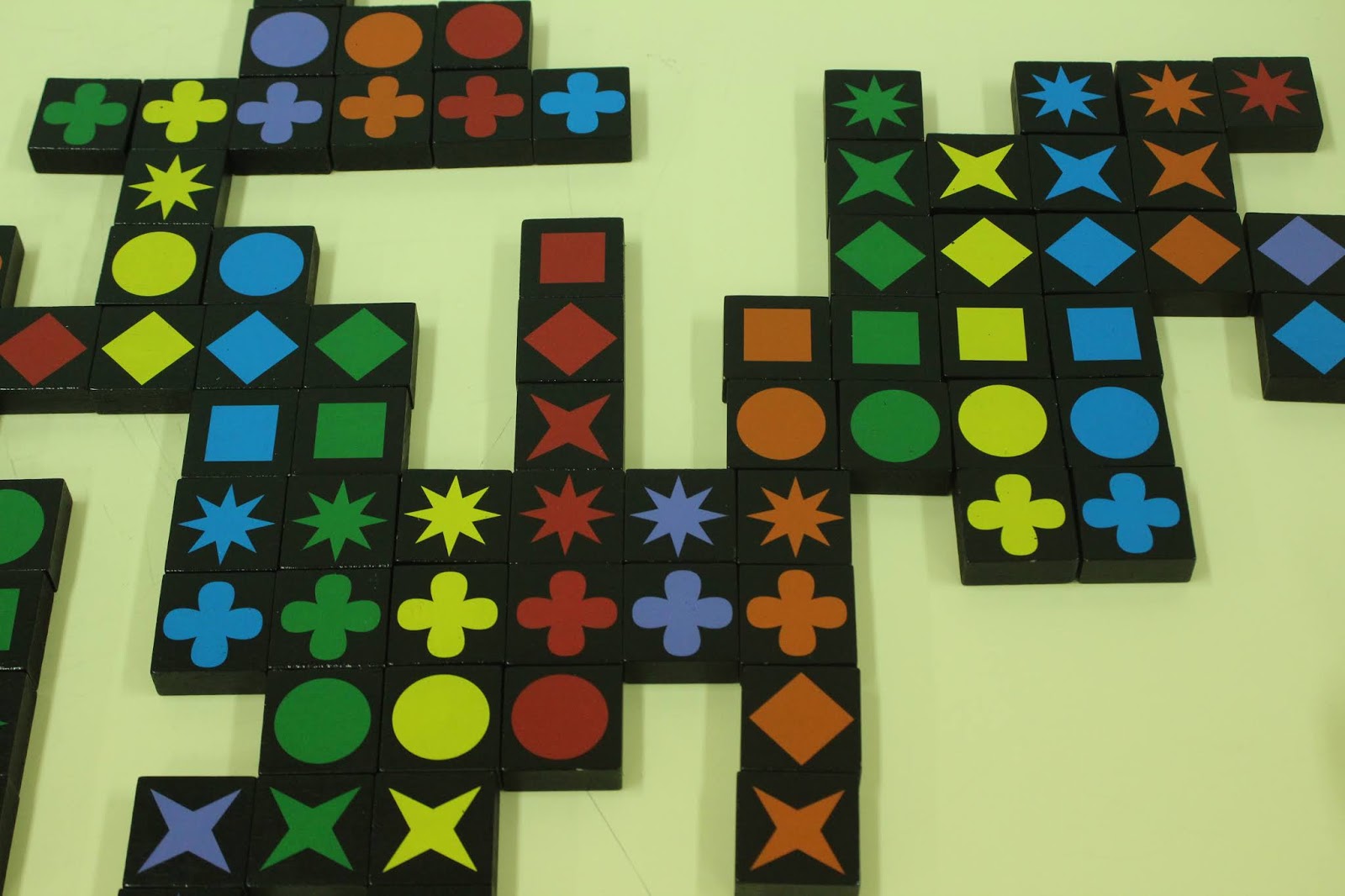
Then came the Qwirkle! A proper name for this game, authored by Susan McKinley Ross, which, being related to Scrabble, uses an alphabet without letters. Or rather, it uses two alphabets, one of colors and another of symbols, thus adding a second dimension to the possible combinations.


There are 6 colors, 6 different symbols and 3 copies of each piece, to form rows and columns, without repeating color or symbol.

The wooden pieces give an additional touch to the set, which sits nicely on any table.

Here, we were 2 at the board, which makes it closer to a classic strategy game. At three or four players it will become more unpredictable, by the new possibilities created, and the ones eliminated at each player’s turn.

To play again!


On a night with few players around, maybe because of the solstice or of the holiday-weekend combination, we still managed to peek at another table, where very lively matches of Zombie, Skull or Monster Match were going on.

See you next time!


Step in and leave your PAW print - Playing Around the World - and follow the PAW tag.
Send a photo of a gaming session, the game title, your name, city, country (and, if you feel like, a short sentence about the game and or a photo of the city) to gamesinbw@gmail.com.

20 June 2019

Defending the Kingdom


You are a hero! Defending the kingdom against the invading hordes, living adventures, meeting characters, performing exploits, using magic, conquering wealth and fame, within a medieval fantasy setting.

This is the life of the players-heroes in Kingdom Defenders, a game of 2018, authored by Germán Palomar Millán, illustrated by David Arenas, and released by Ediciones Primigenio, Spain.

One more game added to the collection, as a result of attending RiaCon, five raffles and chance!

Three senses. Sight, touch, hearing. First impressions.

The box, heavy and in dark tones, evoking the pending threat. A rulebook pleasant to skim, well balanced between text and schemes, appearing to be well structured and simple to read. A board that unfolds, inviting to the game.


Player screens.


Well-illustrated cards and characters; coins and chests; all of this in thick cardboard, nice to handle and that makes that characteristic sound when detaching the parts.


In addition, a bunch of cubes and colorful discs, more traditional, and contrasting with the dominant darker tone. And a few game-specific dice and heroes tokens, both of which in need of a design a little more consistent with the other elements.


The most important is still lacking: impersonate a hero and defend the kingdom!

2 June 2019

In the beginning, there were Whales


The drawings and colors drew my attention. The concept aroused curiosity. The wish to add Portuguese to the most common languages around, in this area, led me to making contact. And the positive answer did the rest!

The Portuguese translation of the rules of Whales Destroying the World, a game by Petr Vojtech with the art of Jindrich Pavlásek, was the first formal collaboration in this fast-paced world of board game creation.  Thank you, Petr!

It's been six months now.

And the collaborations already add up to twenty!

Translations into Portuguese, proofreading in English and Portuguese, comments and suggestions for projects at different stages of development.

Playing with different languages, in search for the best sense. Detecting inconsistencies, errors and typos. Making suggestions. Helping to tell a story. All in all, improving firsthand experiences.

Something I've always been doing over time, in my different lives. Something that I can now do in these territories, where I feel at home.

At first it was the whales. Then came other animals, like bees and chickens. But also, kilt wearing people. And adventurers and warriors with magical arts, in inhospitable lands. Imaginary kingdoms looking for a new sovereign. Merchants in the Mediterranean. The struggle for power in ancient Rome. The arts of calligraphy. The operation of computers. Football matches. Traveling through outer space.

Worlds created by people, who decided to face the challenge of creating the game they dreamed of and that did not exist yet. Worlds created by companies, some small ones taking the first steps, others well established in this market. Worlds disseminated by publishers.

Work that flies over borders, touching land in many points of our globe. From Portugal to Australia, the Czech Republic, Germany, Hungary, Italy, Mexico, Spain, the United Kingdom or the United States of America. For now!

Creating, together, within the reach of a click.

In December, it was the whales. Going backwards one month, you may find the first entry of this blog, in Portuguese and English. A time also marked by the setting up of a Twitter account, joining game-themed Facebook groups and recurrent visits to Kickstarter. Another month towards the past and you may witness the start of the blog launch countdown. And just a small step further back, the very idea of returning to the land of games.

Now, the journey continues.

19 May 2019

At RiaCon, Estarreja, Portugal


RiaCon provided some time travel, between a past, measured in decades, and a brand-new present time, just like all presents use to be.

Morning began with a scheduled reunion, after something close to 35 years (!), with Fernando Zamith, former partner and opponent in the official chess competitions of Braga district (Portugal), at the end of the 1970’s, beginning of the 80’s.

To mark the occasion nothing better than a match of Petróleo, a game of that very same time. The cover of the box and the characteristic board display on the table were the reason behind several "Wow, man! The Petróleo!! ", of whom was passing by and was familiar with this or other editions.
AThen it was time for Fernando to join the Catan tournament and, later, to the Vilar de Mouros sessions, a game of his authorship.

As for me, always with the camera ready to shoot, it was time for a leap in time, to one of the games of this 2019.


That’s how I was invited to join a table in preparation for Escape Plane, one of the recent games of Vital Lacerda.

After the heist, each one must try to recover the maximum of the stash, scattered throughout the city, delude the police in pursuit and reach a safe exit.

As companions of crime, and rivals in the escape, Olavo, Adriano and Sérgio.


Many choices to make: visit locations, collect money, buy protective gear, make contacts, divert attention, try not to get noticed, evade the police, watch the rivals, plan for the final exit, even when it will be in a place unknown at the start.

And the time that is so short!

Other critical decisions will be kept in hold to later in the game. Sprint for the exit or take a riskier approach, aiming for higher gains? To play safe or to risk it all? Ambition? Greed?

I managed to get out. Saved, but not unscathed. A few wounds. Some money in the bags. Far from the success of my fellow burglars.


In the afternoon, the travels across time and space continued. Now to the Brazil from the mid-nineteenth century.

On the table the prototype of Magnanimous, already in its final stages of development. Around the table, the author, Caetano Foschini, and Paulo, already in its second go at the game.


From robber, in the morning, to a land-owner Baron in the afternoon.

Here, the game is obviously different: manage resources, export goods, contain the Paraguayan war, gain political influence, make laws pass or fail, capitalize on the influence and capacities of ministers, and ascend, ascend on the nobility scale.

With cards and dice, lots of dice, to use without rolling.


In the meantime, some conversations, a glance at the well-filled tables, the games on display, the first or secondhand sales, the raffles.

And photographs. Here are some.

Zauberei
El Grande


Tobago

Trickerion


On Mars
CO2, Second Chance


Wingspan
Crokinole


Step in and leave your PAW print - Playing Around the World - and follow the PAW tag.
Send a photo of a gaming session, the game title, your name, city, country (and, if you feel like, a short sentence about the game and or a photo of the city) to gamesinbw@gmail.com.

5 May 2019

Voyages


Let's start by traveling in someone else's memoirs, leading us to April 13, 1969:

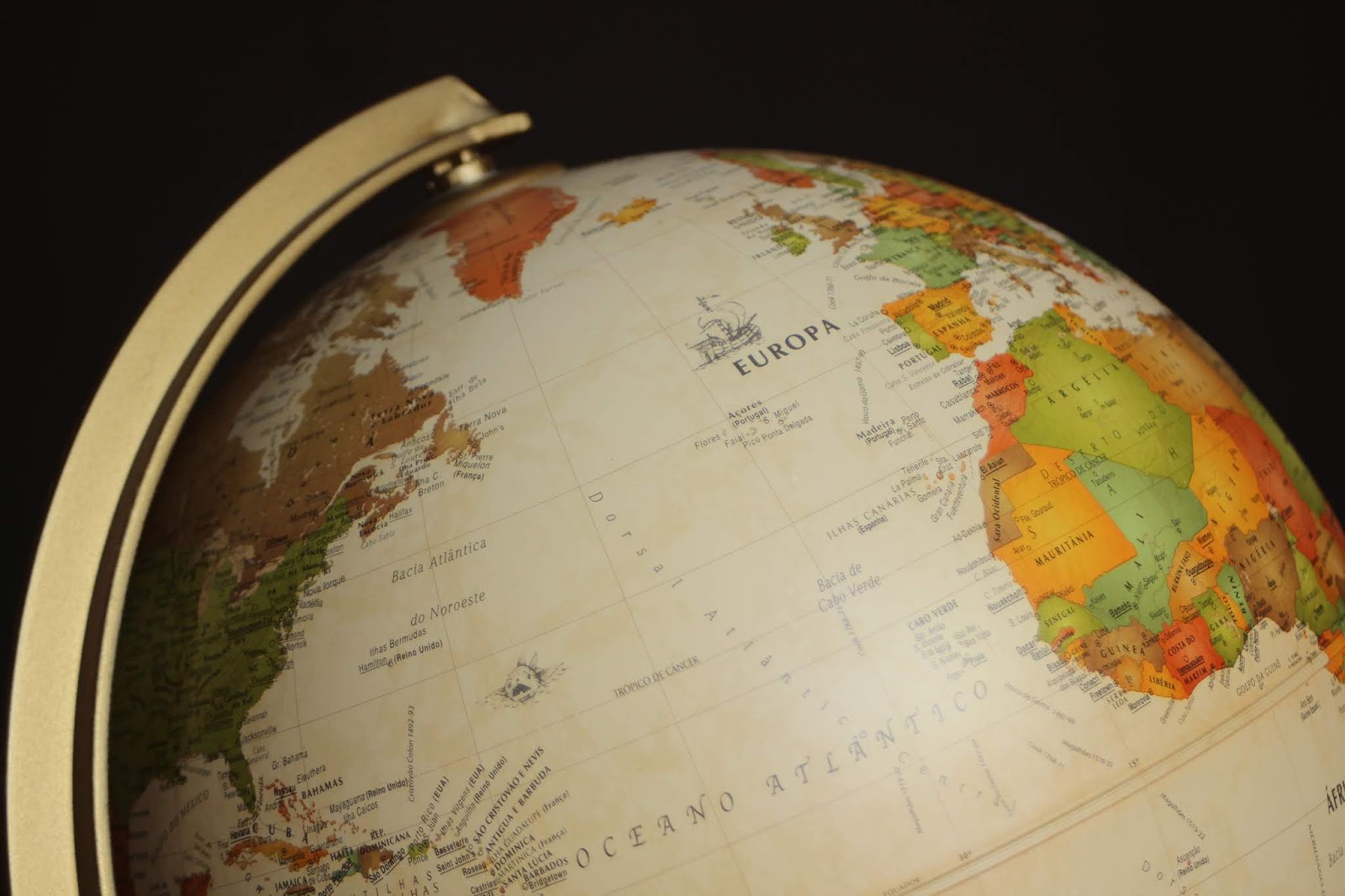
On my sixth birthday I woke up to find the best present I have ever received. Next to my bed was an enormous globe – I had to rub my eyes to make sure it was real! I had always been fascinated by maps and geography, and my favourite childhood stories were those in which my father would recount the voyages of Marco Polo, Columbus and Magellan. It started with my father reading to me from Stefan Zweig’s Conqueror of the Seas: The Story of Magellan. Now our favourite game became tracing the journeys of these great explorers across the globe.

In How Life Imitates Chess (2007), published by William Heinemann.

And who reveals to us this dazzle by discoveries, by other worlds, by recreating adventures, by imagining and by playing, is the very one named Garry Kasparov, one of the best chess players of all time.

Having been born about a year and a half after Kasparov, also I remember a childhood globe in which the blue of the oceans predominated, and in which routes and dates of expeditions were marked. Across the seas and continents, discovering islands, traveling towards the poles with Scott and Amundsen, descending to the Mariana Trench or climbing the Himalayas.

I can’t help thinking on this rather curious proximity between Baku, the capital of Azerbaijan (then part of the Soviet Union), and Guimarães, Portugal, at the end of the 1960’s. As well as noting the shared fascination with maps and geography, games and chess.


Maps that have served me, so many times, as improvised game boards.

Lines and dots. Roads and towns. Roads of red, green or yellow color. Allowing for different displacements rates. Large, medium or small settlements, allowing to accommodate more or fewer parts, assigning bonuses or penalties, being the starting point or the arrival one.

Boards.
For races across geography.
For simple alignments.
For chasing.
For battles.

With labels, customizing pieces from other games. With dice, for movements or for deciding confrontations. And with notebooks, to annotate positions, army effectives, results and dates.

For voyages to the taste of imagination.