Showing posts with label PAW. Show all posts

26 January 2020

A fistful of games


Japanese pop culture and K-pop.

Gaming and tournaments

And also board games.

At the A.F.K Party, organized by FriendZone, at the Rio Novo do Príncipe School in Cacia, near Aveiro, Portugal.


With the Boardgamers Group of Aveiro running the board game section, there were over thirty titles available for the day, suiting all tastes, ages and gaming experience.

From the classics of the late twentieth century, such as Catan and Carcassonne, to those published on the first decade of this century, such as Ticket to Ride or Pandemic, and to the most recent ones, just released in 2019, such as The Taverns of Tiefentahl or Century – A New World.

In a dedicated room, outside the action and the main focus of the meeting, the tables were in action all day long. With people looking to discover games, take a break from other activities or repeat family worlds.

The boardgame room was somewhat outside the centre of the event and the main action. Even so, there was intense action on the tables during all day! With people looking to discover some games, or for a break from the other activities, or even to comeback with friends to already well-known worlds.

This was also the opportunity to experience another handful of games.
At four-player count.
Or three.
Or two.


Century: New World is already the third one in the Century series, but the very first one I played. With the scenario set in the exploration of the Americas, it is a resource management game, which is necessary to collect and exchange various resources.

Specific resource combinations allow you to obtain cards, which in turn provide points, enable access to new board spaces and expand the capability of action, in number or in kind.

The interaction between players, as it is the case in many of these games, focuses on competition for available resource and action spaces.


The Game. Cards with numbers from 2 to 99. To place in two ascending series and two descending series. In collaboration with the other players, but not knowing what each one holds in their hand. Trying to place them all, or at least as many as possible.

Being mandatory to place at least two cards per turn, big jumps in the number sequence become inevitable, sooner or later, hindering the ultimate goal.

A quick game, to play anywhere.


Dragon Castle is a 2017 game, which reminds of the digital Mah-Jong solitaire, where you draw pairs from an initial pyramid of tiles.

Inhere, this pair drawing action is, in fact, the only similarity between both games. The taken tiles are then to be place on the player’s board, to form adjacent groups of the same suit. Once completed, these are turned, enabling the construction of the castle to reach one step higher.

To complete the set there are some Chinese roofs to place on top, yielding more points in the final scoring, beyond, of course, the neat aesthetic touch.


7 Wonders Duel is a game pertaining to the 7 Wonders family, but with its own rules, designed for an experience at two players, a duel, as the name well indicates.

It is a game of civilization development, including the construction of some of the wonders of the world, all the features represented by cards.

There are cards that provide resources and resources that allow you to purchase new cards; some cards are visible from the beginning of the game while others must be discoveries as the duel progresses; cards that grouped are more valuable; a tug-of-war representing military strength; and a bunch of scientific discoveries.

With each player starting with different wonders to build, it is natural that both strategies quickly become very different, adding to the challenge. But in no case one may neglect any of the main areas of development, to the risk of an anticipated and decisive defeat.

An excellent impression from this first play.


And to wrap-up, Onitama, an abstract game, which we can include in the wide chess family.

he main originality is on the movement mechanism, based on cards and not on the characteristics of each piece, as it is most often the case. Each card, named after an animal, represents a different movement pattern, which can be used at will for any one of the player pieces. But beware! The card you play will then become one of the opponent’s cards, and may

This card rotation, meaning an ever-changing possibility of movements, demands a fresh new way of thinking during the course of a game. And since there are more cards than the five used for each match, there is a great variability and thus an enhanced replayability.


With:


Nuno Rebelo

Pedro Chuva

Nuno Gonçalo

Jorge Teixeira


Step in and leave your PAW print - Playing Around the World - and follow the PAW tag.
Send a photo of a gaming session, the game title, your name, city, country (and, if you feel like, a short sentence about the game and or a photo of the city) to gamesinbw@gmail.com.

19 December 2019

PAW in Croatia

Nemesis on the table, in Croatia, by Una Montag


Playing in Croatia.
Or in outer space.
Trying to survive the Invaders.

Thanks Una!


Step in and leave your PAW print - Playing Around the World - and follow the PAW tag.
Send a photo of a gaming session, the game title, your name, city, country (and, if you feel like, a short sentence about the game and or a photo of the city) to gamesinbw@gmail.com.

3 December 2019

PAW in New York City

Union Square, Manhattan, NYC, February 2012, by Miguel Coutinho


From a chat around games to the blog's name.
From the name of the blog to a travel memory.
In colour. And in Black and White.

Thanks Miguel!


Step in and leave your PAW print - Playing Around the World - and follow the PAW tag.
Send a photo of a gaming session, the game title, your name, city, country (and, if you feel like, a short sentence about the game and or a photo of the city) to gamesinbw@gmail.com.

29 October 2019

A night with games


In this occasion at CUFC - Faith and Culture University Centre, by the University of Aveiro, thus becoming the third home for playing board games in the Aveiro Region (Portugal), after S. Bernardo and Borralha, Águeda. Lively tables with not that many empty seats around them, holding promises for the last Mondays of every month to come.

Besides chatting and taking some photos, for the record, I also managed to have a go at some games.

Starting with Xodul, a prototype by Sílvia Rodrigues combinig some pieces and movements based on the more traditional chess, on shogi and xiang-qi, with some original features. A challenge for those enjoying abstract games for two, in black and white!

Then it was time to guide new players into Azul, a game that is becoming increasingly popular, for its components, the game play itself and, no doubt, by the rules so easy to understand and its short duration.

And, to end the night, a play of Sagrada, for some time in the waiting list. A colourful game, matching the underlying stained-glass theme, with a simple set of rules, not that easy to master, and a dash of luck attached to the countless dice that will bring the stained-glasses to life.

More to come, next month!


Playing the Xodul prototype


Teaching Azul


Having a go at Sagrada


Step in and leave your PAW print - Playing Around the World - and follow the PAW tag.
Send a photo of a gaming session, the game title, your name, city, country (and, if you feel like, a short sentence about the game and or a photo of the city) to gamesinbw@gmail.com.

29 September 2019

A Saturday afternoon


Saturday was a day for travelling.

It has come to an end in the warm waters of Tungaru, an archipelago in the South Pacific, sailing from island to island, building monuments, recruiting inhabitants, exchanging fish, shells, coconuts and pearls, and, of course, gathering colourful flowers.

It was an opportunity to play test this game, which is not yet in a store near you, since it still is undergoing the final development stages.

Designed by Louis and Stefan Malz, illustrated by Andrew Bosley, it will be published by Alley Cat Games, UK, and is expected to hit Kickstarter in late October.


The afternoon had begun in Egypt, in Luxor, on the bank of the Nile and very close to the Valley of the Kings. A group of adventurers exploring the riches of the Luxor temple, while trying to be the first one gaining access to the Pharaoh's tomb.

Luxor, designed by Rüdiger Dorn, illustrated by Dennis Lohausen, published by Devir (2018).


Then I headed east, towards India, into the state of Rajasthan, arriving at its capital, Jaipur. To learn, the hard way, the art of a trading duel, amongst precious stones, gold and silver, spices or fabrics, and herds of camels.

Jaipur, designed by Sébastien Pauchon, illustrated by Vincent Dutrait and Alexandre Roche, published by Game Works (2009).


It was then that I abandoned land and ventured into the seas, sailing all the way across to the Caribbean, to Jamaica, Port Royal. Testing ambition and luck, with colourful galleons, expeditions, sailors and pirates, merchants, players, priests, maidens and all other customary characters you usually find around ports, where the golden doubloons reign.

Port Royal, designed by Alexander Pfister, illustrated by Klemens Franz  and  Atanas Lozanski, published by Pegasus Games (2014).


And that's how I finally decided to cross the Pacific, in search of quieter lands.

A Saturday afternoon, dynamized by the Group of Boardgamers of Aveiro, in S. Bernardo, Aveiro, Portugal. A special thanks to Carlos for having served as a guide in the initial part of the journey!


Step in and leave your PAW print - Playing Around the World - and follow the PAW tag.
Send a photo of a gaming session, the game title, your name, city, country (and, if you feel like, a short sentence about the game and or a photo of the city) to gamesinbw@gmail.com.

3 September 2019

An Gleann Mòr


In the Great Valley, at last.
The Great Glen.
Glen More.
An Gleann Mòr.

Travelling. Across High Lands.
Amid the mist, beneath the hidden skies.
Amid the clouds, out in the rain.
Land of water. Land of waters.

To the sound of the wind.
To the sound of Gaelic.
Turning it even more mysterious.

An Gleann Mòr.
From Inbhir Nis to Fort Williams, 73 miles shaping Scotland.

Urquhart Castle, Caisteal na Sròine, close by Drumnadrochit.
Watching, for centuries.
Over the lake.


The lake.
Loch Ness.
The first one, for those who come from the north.

The game embraced this journey, searching for its origins.
Traveling light, with no box, out of the box.
Glen More.


Loch Lochy. Loch Lòchaidh.

Just after passing by Loch Oich. Loch Omhaich.

Lakes that succeed along the valley, forming the Caledonian Canal.

The highest mountain was not to be seen, protected by a blanket of clouds.
Beinns, mountain, as in Beinn Nibheis, Ben Nevis.
The highest point of the big island, here measured in feet, 4400 of them.
After Fort Williams, turning west, towards the jagged shoreline.


Loch Shiel. Loch Seile.

A sight dismissing any words.

You do not feel the falling rain anymore.

Time slows down.

It almost stops.


The game embraced the journey.

The tiles have left the box.

They have found their roots.


Eilean Donan Castle.
The castle of Donan island.

Eight Centuries of history.
From the Vikings to the Jacobites.

Rebuilt over 20 years in the early 20th century.
By the sight and hands of a military and his chief of works.
John Macrae-Gilstrap and Farquar Macrae.


Time to head to the island.
To the Isle of Skye.
Exchanging a visit to the castles of Armadale and Moil by the Old Men of Storr.

Climbing, climbing and climbing even more.
Until reaching the mists.
Above the rainbow.

Before the descent.
In the rain, sent by the Old Men to keep us away.
With this rain, that is already part of us.


In Clans Map of Scotland, Bartholomew


Time to leave behind this land of Clans.
The game will return to the box.
For now.

An Gleann Mór.

22 June 2019

Summer PAW


On the longest day, with the sun setting after 21:00, the half-hour trip was made at dusk.

Direction: Águeda; better said, Borralha, a small place; yet more precisely, the parish council building. First time at the site, not far from Águeda’s Municipal Stadium, home for Recreio Desportivo de Águeda since Euro 2004, and just above the Palace of Borralha, a building classified as monument of public interest.

Reason: The monthly meeting organized by Aveiro Boardgamers Group. Finally managing to attend one of those, after several missed opportunities due to conflicting agendas.

Aim: To try a few more games.


As a starter, Bärenpark, a 2017 game, authored by Phil-Walker Harding and with the art of Klemens Franz. The cover does not deceive: it really is a park with bears, one to be built by each player.


At the beginning, an empty land and a set of diverse elements: green areas, recreational parks, food zones, water lines, sanitary facilities, animal enclosures and, of course, the very own animals.

As important, if not even more, than the motifs in the parts, are the actual size, shapes and points associated with each element.

This is because the main goal is to completely fill the terrain of the park, through a judicious and timely choice of the different elements, in a kind of Tetris-way, so in vogue in many games.

Easy to learn, fun and fast to play.


And here's a part of my Bear Park!

In the base version of the game, the theme falls behind rather quickly, since the only real interaction between the different pieces is their form. However, there are advanced rules according extra points for the player who, for instance, has built the largest water line, or the one who managed to gather a certain number of animals of a given species. An apparently small change entailing a very different look to gameplay.


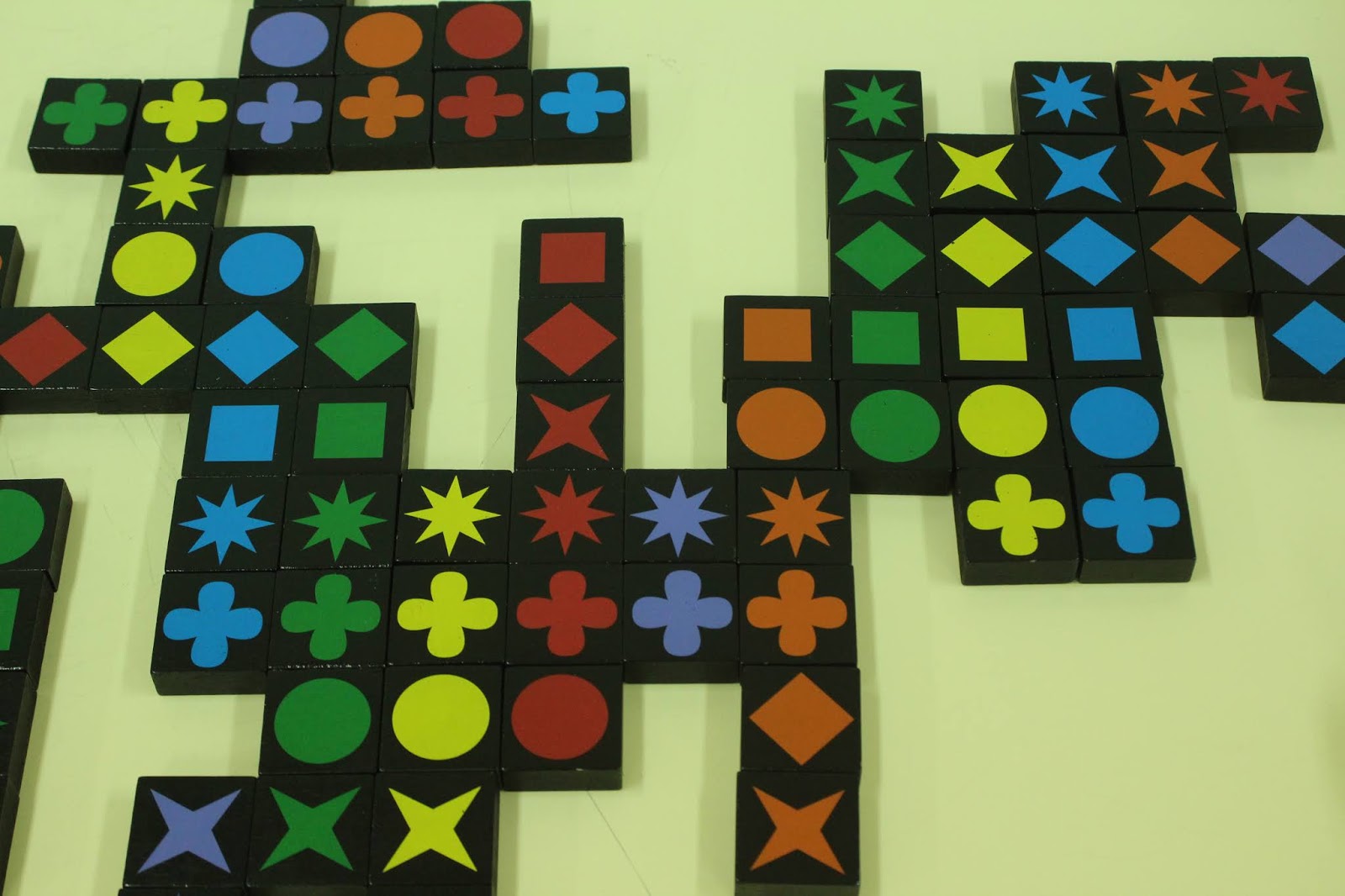
Then came the Qwirkle! A proper name for this game, authored by Susan McKinley Ross, which, being related to Scrabble, uses an alphabet without letters. Or rather, it uses two alphabets, one of colors and another of symbols, thus adding a second dimension to the possible combinations.


There are 6 colors, 6 different symbols and 3 copies of each piece, to form rows and columns, without repeating color or symbol.

The wooden pieces give an additional touch to the set, which sits nicely on any table.

Here, we were 2 at the board, which makes it closer to a classic strategy game. At three or four players it will become more unpredictable, by the new possibilities created, and the ones eliminated at each player’s turn.

To play again!


On a night with few players around, maybe because of the solstice or of the holiday-weekend combination, we still managed to peek at another table, where very lively matches of Zombie, Skull or Monster Match were going on.

See you next time!


Step in and leave your PAW print - Playing Around the World - and follow the PAW tag.
Send a photo of a gaming session, the game title, your name, city, country (and, if you feel like, a short sentence about the game and or a photo of the city) to gamesinbw@gmail.com.

19 May 2019

At RiaCon, Estarreja, Portugal


RiaCon provided some time travel, between a past, measured in decades, and a brand-new present time, just like all presents use to be.

Morning began with a scheduled reunion, after something close to 35 years (!), with Fernando Zamith, former partner and opponent in the official chess competitions of Braga district (Portugal), at the end of the 1970’s, beginning of the 80’s.

To mark the occasion nothing better than a match of Petróleo, a game of that very same time. The cover of the box and the characteristic board display on the table were the reason behind several "Wow, man! The Petróleo!! ", of whom was passing by and was familiar with this or other editions.
AThen it was time for Fernando to join the Catan tournament and, later, to the Vilar de Mouros sessions, a game of his authorship.

As for me, always with the camera ready to shoot, it was time for a leap in time, to one of the games of this 2019.


That’s how I was invited to join a table in preparation for Escape Plane, one of the recent games of Vital Lacerda.

After the heist, each one must try to recover the maximum of the stash, scattered throughout the city, delude the police in pursuit and reach a safe exit.

As companions of crime, and rivals in the escape, Olavo, Adriano and Sérgio.


Many choices to make: visit locations, collect money, buy protective gear, make contacts, divert attention, try not to get noticed, evade the police, watch the rivals, plan for the final exit, even when it will be in a place unknown at the start.

And the time that is so short!

Other critical decisions will be kept in hold to later in the game. Sprint for the exit or take a riskier approach, aiming for higher gains? To play safe or to risk it all? Ambition? Greed?

I managed to get out. Saved, but not unscathed. A few wounds. Some money in the bags. Far from the success of my fellow burglars.


In the afternoon, the travels across time and space continued. Now to the Brazil from the mid-nineteenth century.

On the table the prototype of Magnanimous, already in its final stages of development. Around the table, the author, Caetano Foschini, and Paulo, already in its second go at the game.


From robber, in the morning, to a land-owner Baron in the afternoon.

Here, the game is obviously different: manage resources, export goods, contain the Paraguayan war, gain political influence, make laws pass or fail, capitalize on the influence and capacities of ministers, and ascend, ascend on the nobility scale.

With cards and dice, lots of dice, to use without rolling.


In the meantime, some conversations, a glance at the well-filled tables, the games on display, the first or secondhand sales, the raffles.

And photographs. Here are some.

Zauberei
El Grande


Tobago

Trickerion


On Mars
CO2, Second Chance


Wingspan
Crokinole


Step in and leave your PAW print - Playing Around the World - and follow the PAW tag.
Send a photo of a gaming session, the game title, your name, city, country (and, if you feel like, a short sentence about the game and or a photo of the city) to gamesinbw@gmail.com.

22 April 2019

PAW in Chaves, Portugal


The Serra do Brunheiro, seen from Samaiões.

Just a few kilometres north, is the Tâmega River, the Trajano Bridge, the Termal Springs, and the city of Chaves, the Aquae Flaviae of the 1st century, name derived from the roman emperor Titus Flavius Vespasianus.

Signs of the empire that would come to pass before the Barbarians. Later came the Moors, afterwards the reconquest and finally the integration in the Kingdom of Portugal.

The inhabitants lost the condition of Roman subjects, but they are still called Flavienses.


Azul (Blue), from the arabic glazed tiles, and also from the ever present colour
Foto by Leonor Conceição


Pandemic, cooperating to eradicate global epidemics

Step in and leave your PAW print - Playing Around the World - and follow the PAW tag.
Send a photo of a gaming session, the game title, your name, city, country (and, if you feel like, a short sentence about the game and or a photo of the city) to gamesinbw@gmail.com.