Showing posts with label Portugal. Show all posts

22 June 2019

Summer PAW


On the longest day, with the sun setting after 21:00, the half-hour trip was made at dusk.

Direction: Águeda; better said, Borralha, a small place; yet more precisely, the parish council building. First time at the site, not far from Águeda’s Municipal Stadium, home for Recreio Desportivo de Águeda since Euro 2004, and just above the Palace of Borralha, a building classified as monument of public interest.

Reason: The monthly meeting organized by Aveiro Boardgamers Group. Finally managing to attend one of those, after several missed opportunities due to conflicting agendas.

Aim: To try a few more games.


As a starter, Bärenpark, a 2017 game, authored by Phil-Walker Harding and with the art of Klemens Franz. The cover does not deceive: it really is a park with bears, one to be built by each player.


At the beginning, an empty land and a set of diverse elements: green areas, recreational parks, food zones, water lines, sanitary facilities, animal enclosures and, of course, the very own animals.

As important, if not even more, than the motifs in the parts, are the actual size, shapes and points associated with each element.

This is because the main goal is to completely fill the terrain of the park, through a judicious and timely choice of the different elements, in a kind of Tetris-way, so in vogue in many games.

Easy to learn, fun and fast to play.


And here's a part of my Bear Park!

In the base version of the game, the theme falls behind rather quickly, since the only real interaction between the different pieces is their form. However, there are advanced rules according extra points for the player who, for instance, has built the largest water line, or the one who managed to gather a certain number of animals of a given species. An apparently small change entailing a very different look to gameplay.


Then came the Qwirkle! A proper name for this game, authored by Susan McKinley Ross, which, being related to Scrabble, uses an alphabet without letters. Or rather, it uses two alphabets, one of colors and another of symbols, thus adding a second dimension to the possible combinations.
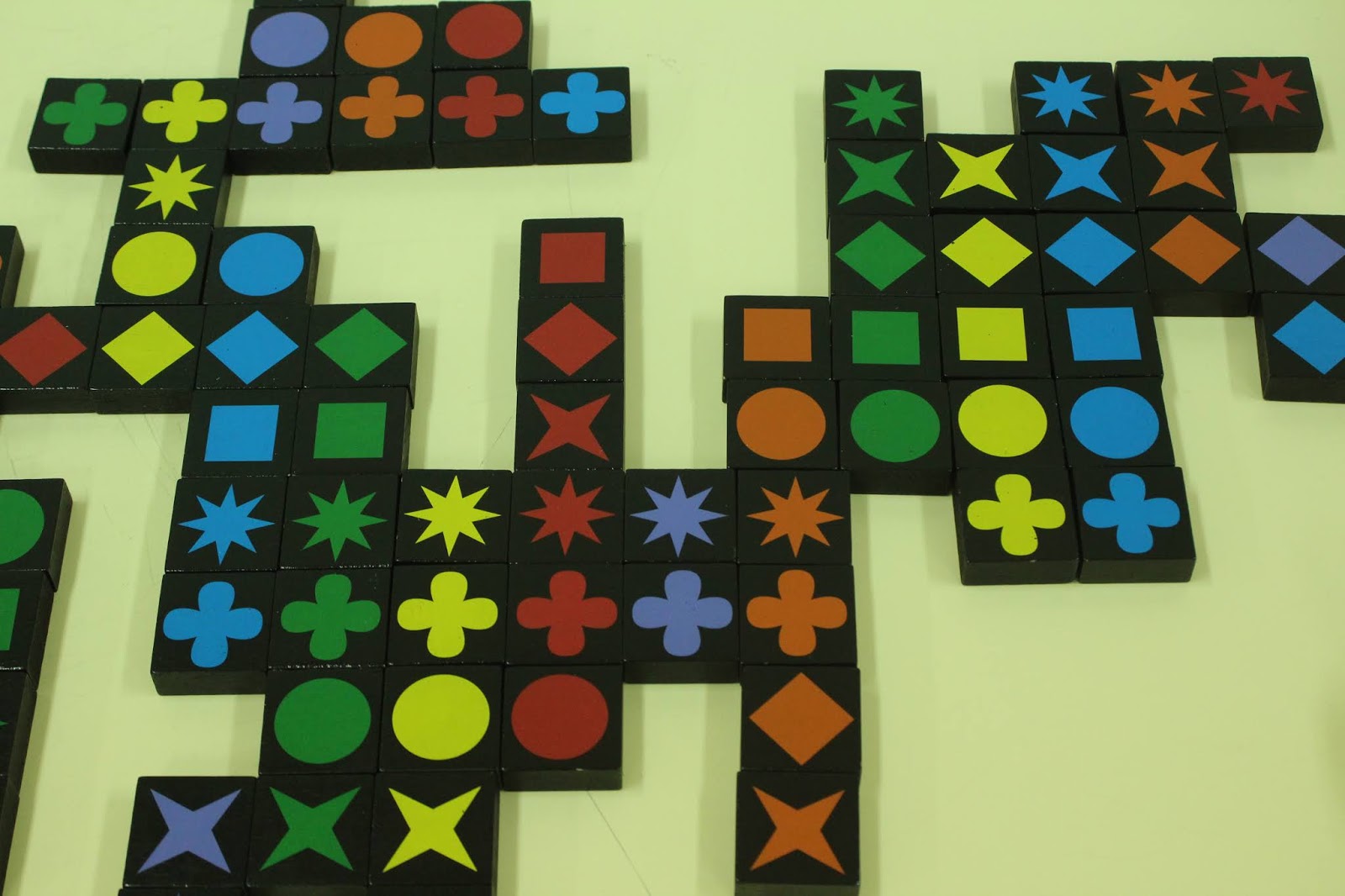


There are 6 colors, 6 different symbols and 3 copies of each piece, to form rows and columns, without repeating color or symbol.

The wooden pieces give an additional touch to the set, which sits nicely on any table.

Here, we were 2 at the board, which makes it closer to a classic strategy game. At three or four players it will become more unpredictable, by the new possibilities created, and the ones eliminated at each player’s turn.

To play again!


On a night with few players around, maybe because of the solstice or of the holiday-weekend combination, we still managed to peek at another table, where very lively matches of Zombie, Skull or Monster Match were going on.

See you next time!


Step in and leave your PAW print - Playing Around the World - and follow the PAW tag.
Send a photo of a gaming session, the game title, your name, city, country (and, if you feel like, a short sentence about the game and or a photo of the city) to gamesinbw@gmail.com.

22 April 2019

PAW in Chaves, Portugal


The Serra do Brunheiro, seen from Samaiões.

Just a few kilometres north, is the Tâmega River, the Trajano Bridge, the Termal Springs, and the city of Chaves, the Aquae Flaviae of the 1st century, name derived from the roman emperor Titus Flavius Vespasianus.

Signs of the empire that would come to pass before the Barbarians. Later came the Moors, afterwards the reconquest and finally the integration in the Kingdom of Portugal.

The inhabitants lost the condition of Roman subjects, but they are still called Flavienses.


Azul (Blue), from the arabic glazed tiles, and also from the ever present colour
Foto by Leonor Conceição


Pandemic, cooperating to eradicate global epidemics

Step in and leave your PAW print - Playing Around the World - and follow the PAW tag.
Send a photo of a gaming session, the game title, your name, city, country (and, if you feel like, a short sentence about the game and or a photo of the city) to gamesinbw@gmail.com.

17 March 2019

PAW, at LeiriaCon 2019


Weekend full of games.

Saturday in Estarreja, Portugal. Another chess match for the 2nd Division Team National Championship, Series A. Third consecutive win and third team win.

Sunday, heading south. Departure at 8:30 a.m. Gray sky, contrasting with the last days. Highway practically deserted. One hour of quiet driving time. Destination: Praia de Vieira de Leiria, for the last day of Leiriacon, 2019 harvest, the 14th in history.


Table booked for ten in the morning, with Yinzi, on the menu.

A truly new game, just released, authored by the Portuguese José Carlos Santos and Luís Costa, with the beautiful work of illustration by Harald Lieske, and published by the German publisher Spielworkxx.

As a host, José Carlos Santos, himself, to uncover some of the secrets of this game of commerce, set in the China of the Ming dynasty. A very rich game, full of choices, interconnected mechanisms, small details and subtleties. Clearly to repeat the experience, which deserves a more time-consuming tasting, so to discover the many flavors! 


From a new game we passed to one that is still to be!

Trying out a prototype with an original theme.


A pallet of characters, which will be posing for a painting, but full of whims about their position on the setting, the companions, the postures.

A fast paced, information-seeking game, which undoubtedly will put the memory to the test.


And, to end the day, a game that already enjoys great popularity, despite having only a couple of years. Azul, by Michael Kiesling, with azulejos, ceramic tiles of Portugal, as a theme. Aesthetically pleasing, easy to learn, fast to play, allowing for different strategies. I still have to experience its flow with three and four players, but it is clear why it has so many fans!


And that's how it was, this visit to Leiriacon.

With an excellent atmosphere, great friendliness and relaxation, a strong international presence and reference names of this world of games.


Already looking forward to the 2020 Convention!

And a little more of blue, before the sun sets.


Step in and leave your PAW print - Playing Around the World - and follow the PAW tag.
Send a photo of a gaming session, the game title, your name, city, country (and, if you feel like, a short sentence about the game and or a photo of the city) to gamesinbw@gmail.com.

9 February 2019

PAW, Engraved in stone


PAW. Playing around the World. Today in different format, leaving the rooms where usually games are played, leaving the tables, the boards that may be folded, the boxes.

Traveling through the territory.
From the museum to the churches and castles.
From the Portuguese capital, Lisbon, to the Beira Alta border.
Looking over the rest of the country and beyond.

Traveling through time.
Time of players and builders, or builders-players.
Time of the archaeologists, curators, historians, in search of memory.
Visitor time.

Traveling along the family tree.
In a text with photographs sent by my daughter and papers written by my mother!

About immovable boards, engraved on stone, which remain after the people are no long, waiting for others to come. Adapting the lyrics of Barclay James Harvest, "Now the People Are Gone Just the Games’ Boards Alone”.


Let’s start at the National Museum of Natural History and Science, in Lisbon, with a game reproduction and a factsheet on the Alguergue, in the Alguergue of 12 variety (Photos by Leonor Conceição).

A 5x5-point board. A dozen pieces on each side, leaving only a free intersection at the beginning of the game.

Lines that connect the dots, indicating the possible movements. Moving only one step at a time, from one point to an unoccupied neighbour point.

Captures, leaping over an adjacent opponent's piece to the immediately following intersection, provided it is empty. Possibility of multiple captures, in sequence, in one single move.

A classic game, a two-sided fight.

Let's leave the museum, heading to Beira Alta, Sabugal County, on the border with Spain. 

Let's travel, in the writing of Manuela de Alcântara Santos, to find alguergue boards carved on granite and to discover a little more of its history [1]. 

Alguergue, an word coming from ancient Arabic Al-Quirkat, small stone. Word that denotes the close origin of these games that have traveled to us: introduced in the Iberian Peninsula by overseas Muslims.

Not a game, but a family of games, with common principles, but with different boards and number of stones.


Here, in Sabugal, these are five alguergues of other variants, designated 9 and 3, according to the number of stones on each side.

Engraved boards may be found in Sabugal, Vila Maior, Vila do Touro, Sortelha and Rendo. In rocky outcrops or constructions. All probably from medieval times.


From Sabugal let’s move to the whole country finding more, many more, games engraved on the stone.

Up to 250 boards identified in the work of Lídia Fernandes [2], with a clear majority of alguergues of 12 and 9, from north to south, from Valença to Silves, some dated from the X-XI centuries.


And we go beyond, crossing borders of countries, regions or tribes, communicating in different languages, using distinguished names, but playing the same games: Alquerque (Spain), Marro (Catalonia), Marelle (Italy), Marella (Sicily), Mérelles (France), Bara-Guti (India), Natt klab ash-shawk (Palestine), Damma (Sara), Aiyawatstani (New Mexico), among many others [3].


[1] Santos, Manuela de Alcântara (2012), Tabuleiros de jogos de alguergue no concelho de Sabugal, [Boards of alguergue games in Sabugal county], Sabucale – Revista do Museu do Sabugal, 2012, n.º 4, pp 83-96.

[2] Fernandes, Lídia (2013), Tabuleiros de jogo inscritos na pedra – Um roteiro lúdico português, [Game boards engraved in stone - a Portuguese ludic itinerary ], Apenas Livros.

[3] Murray, H.J.R (1952), A history of board-games other than chess, Oxford at the Clarendon Press.


Step in and leave your PAW print - Playing Around the World - and follow the PAW tag.
Send a photo of a gaming session, the game title, your name, city, country (and, if you feel like, a short sentence about the game and or a photo of the city) to gamesinbw@gmail.com.

10 January 2019

PAW in Estarreja, Portugal - Time, Space, Matter


PAW in competition mode.

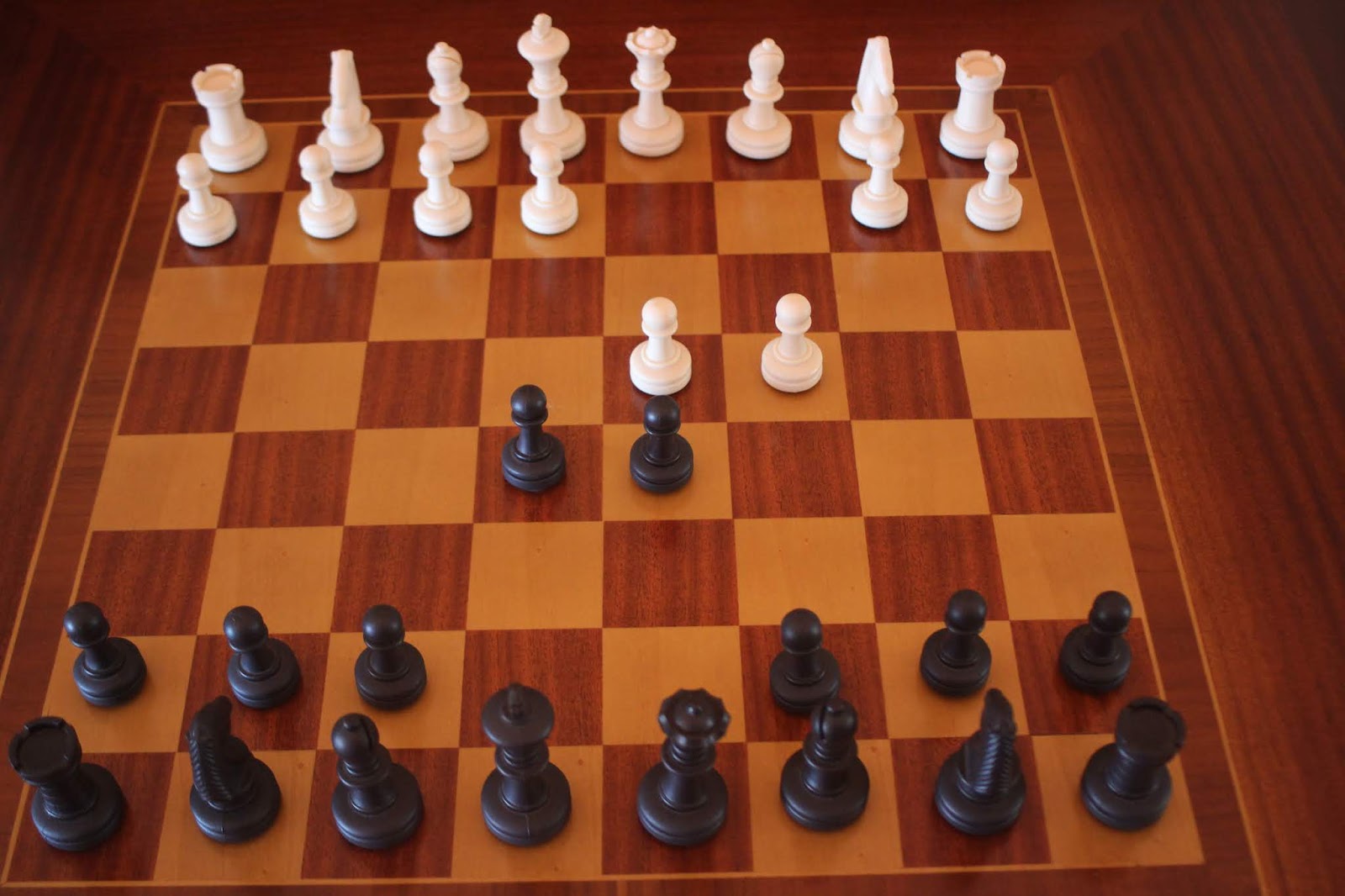
National Teams Competition, 2nd League. Day 5 in January. Playing at home, in Estarreja, commanding the black forces. Photos reproducing some of the game positions.

1. d4 d5 2. c4 e5. The Albin counter gambit. A less frequent choice, to push the opponent away from the comfort zone. Goal achieved! And black swiftly took the initiative.

With initiative came Time: faster development, helped by inaccurate white moves; after move 12 an advantage of, at least, 3 tempi.


Time turned into Space, with a King protected but ready to spring into action, a controlled center, and an attack in the Queen’s side, where the opponent's King is exposed.

Space turned into Matter. Black knights (they always look better in the movies, right?) prevailed. 40% of total game moves were horse riding, including five in a row. Concentration of troops, threats, diversion of defenders, breaking point. First, a pawn advantage. Then, another one.


The outcome seemed inevitable, being only a matter of care and time.

White just moved the tower. Find the solution for the problem: Black to move; mate in 2.

Victory after just over 2 hours and 30 minutes of play.
Mission accomplished.

Step in and leave your PAW print - Playing Around the World - and follow the PAW tag.
Send a photo of a gaming session, the game title, your name, city, country (and, if you feel like, a short sentence about the game and or a photo of the city) to gamesinbw@gmail.com.

3 January 2019

PAW in Guimarães

Historic Centre of Guimarães, Portugal, World Heritage


Returning to the Craddle on the Holiday Season. The Historic Centre of Guimarães is listed as a UNESCO World Heritage site, since 2001 (https://whc.unesco.org/en/list/1031/).

On the table: Estoril 1942, a first; Pandemic, always a good choice, cooperative work to save the World; Tsuro, quick and beautiful, and with head on collisions assured in a 6-player game; and Photosynthesis, with four players, still needing to master the solar cycle and the flow of time!


Estoril 1942


Pandemic


Tsuro


Photosynthesis


Step in and leave your PAW print - Playing Around the World - and follow the PAW tag.
Send a photo of a gaming session, the game title, your name, city, country (and, if you feel like, a short sentence about the game and or a photo of the city) to gamesinbw@gmail.com.