"Comrade Zhukov: Comrade Mikoyan is acting improperly, he's pushing us toward capitulation. We must insist on a firm position. Comrade Shepilov: the step was extreme, but correct. Real power is with the troops. To make further concessions would be regarded as weakness. Comrade Furtseva: Comrade Mikoyan, apparently, is mistaken about Nagy. They released 1,000 who had been arrested. Comrade Khrushchev: Mikoyan is acting as he said he would. Comrade Mikoyan supported a position of non-intervention, but our troops are there."
Working notes from the session of the CPSU CC Presidium, 26 october 1956
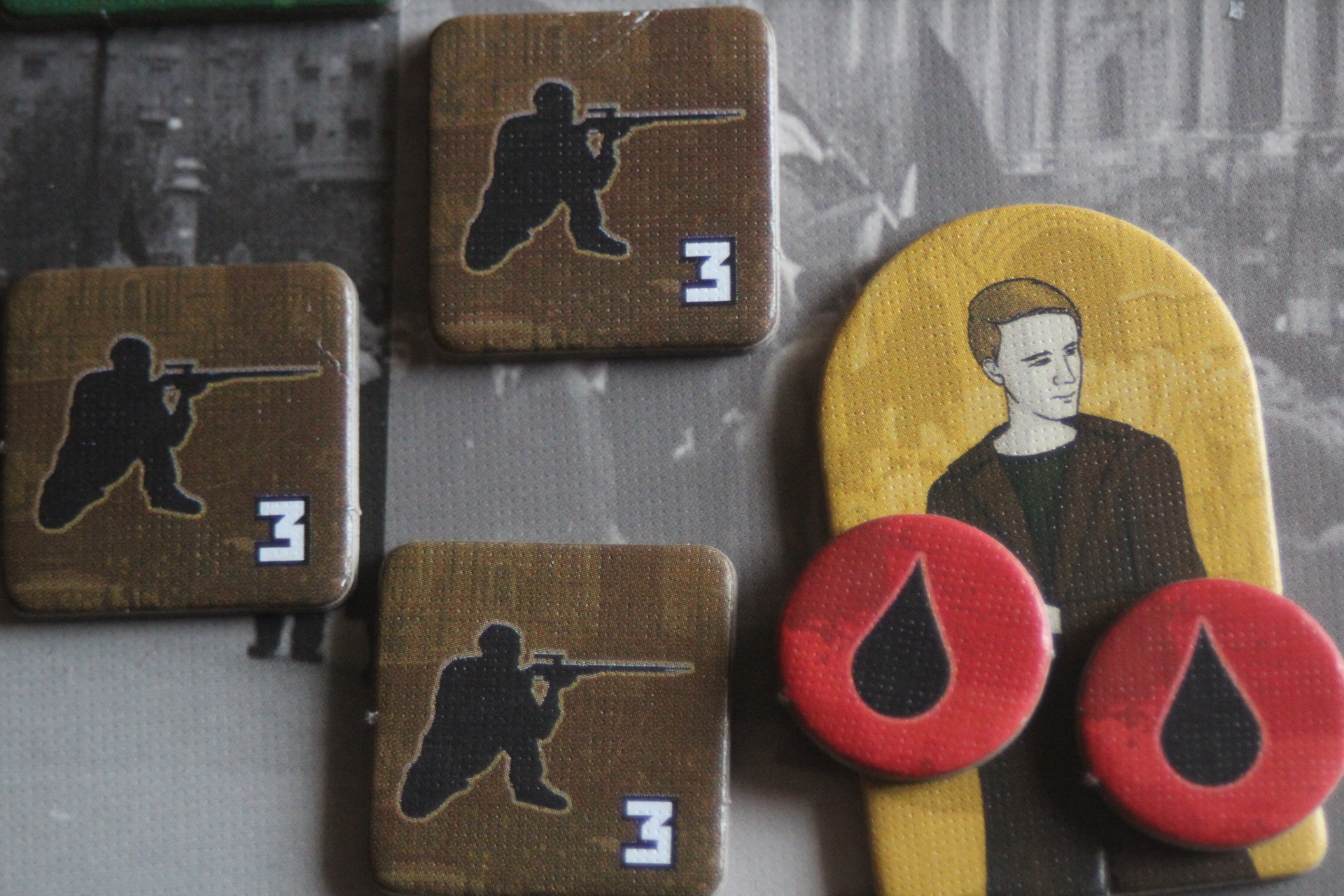
I open the box, remove and unfold the game board, a map of Budapest, laying it on the table. Then, I take the components and place them over the map: different sets of cards, two dice, counters in different shapes and colours - green rectangles, brown triangles and squares, red hexagons, orange octagons -, three transparent hemispheres, player tokens, circles bearing the words action, free movement, and inactive, black drops over red circles. Abstract components. Top-notch components and production from Mighty Boards, I may add.
Slowly, they start to change in meaning, pulling me back across space and time, towards Budapest 1956.
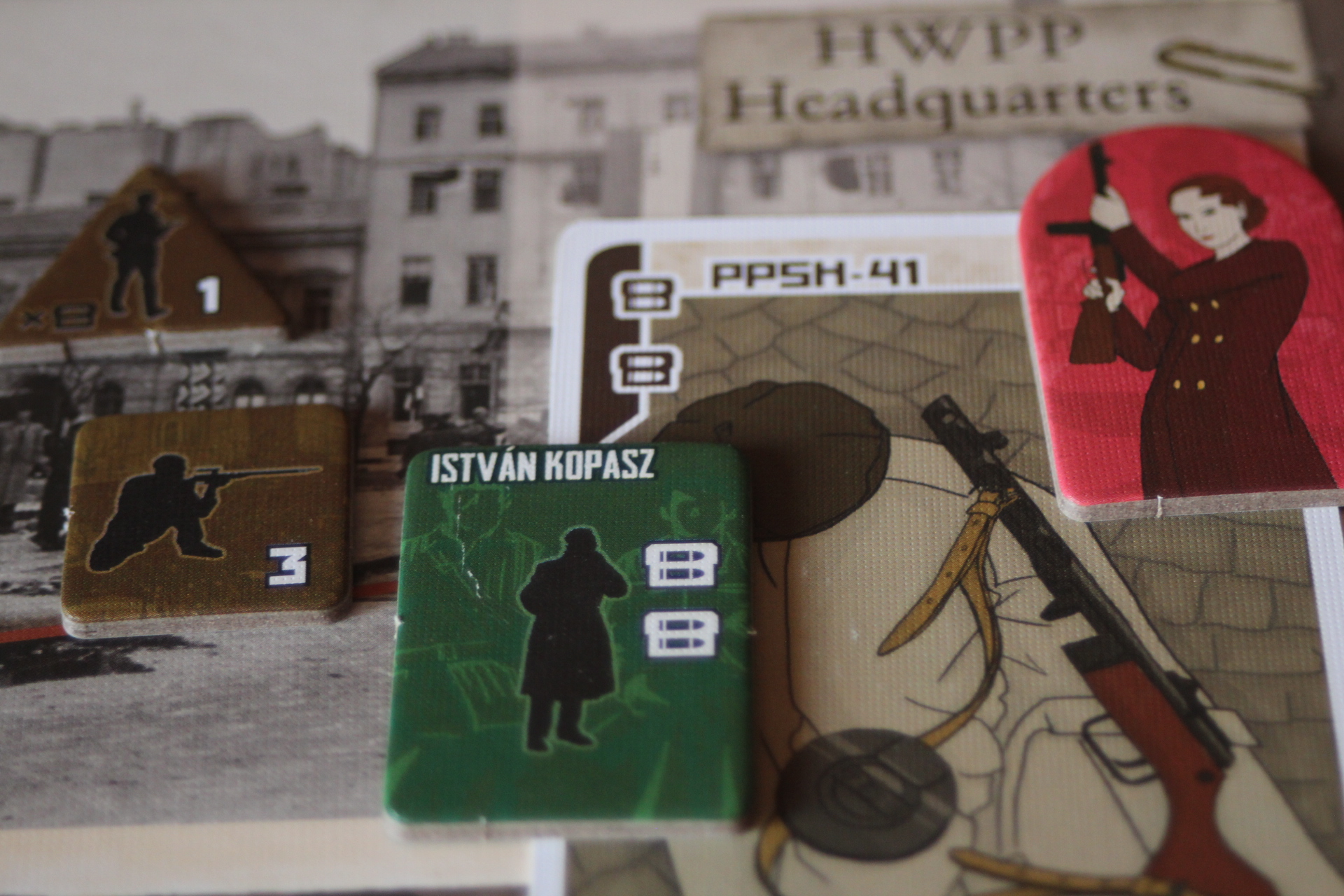
Black and white pictures on the board, portraying buildings, people, statues, armed forces. Decks of cards labelled as General Zhukov, State Protection Agency, Revolutionary Card, Day of the Revolution, Armed Uprising, The Turning Tide, or Event. Green rectangles with silhouettes of men and women, bearing names such as István Kopasz, and icons such as ammunition, Molotov cocktails, radios. The brown triangles and squares with soldier silhouettes, the red hexagons featuring armoured vehicles, the orange octagons showing barricades. The drops are, well, drops, blood drops.

In the box, not one, but three booklets. One with the same cover from the box: the woman holding a rifle in the left hand, the Hungarian flag stripped from the coat of arms in the right one; in the background, almost as a black and white picture were it not for the flames, soviet tanks are set ablaze, in a street battle; the red, white, and green from the flag, ever present in the graphic design, as a unifying element. A beautiful piece of art by Kwanchai Moriya. As the art of the Soviet cards, also authored by Kwanchai, the revolutionary cards by Katalin Nimmerfroh, and the graphic design by Sami Laakso.
This is the introductory booklet, containing a game overview, the setup for all three modes of play, an account of the revolution, and a set of appendixes with detailed information on all the cards and all the fighters.
Then, there is the green booklet, the Zhukov ruleset, for the solo and cooperative game, where the player or players take the revolutionary side.
The third one is the red booklet, the Conflict ruleset, where one of the players will take the side of the Soviet and State controlled forces.
Booklets in red and green, nicely laid out, with room to breathe, clear instructions, and suitable examples. And with many small details enriching the playing experience and guiding the player in a journey throughout history and culture: black and white archive photos, history insights, and the phonetics of Hungarian names.
The map of central Budapest, with the Danub river and the many bridges. Bem Statue and the University of Technology on one of its banks. On the other, Kossuth Square nearby the Parliament and Ministry buildings. Killian Barracks, the Corvin Passage, Corvin Theater. The Radio and the National Museum. Blaha Lujza Square and Stalin Square. Names and places still unfamiliar, waiting for us to venture into those streets.
A simple yet very efficient iconography indicates all you need to know for setting up initial forces, deploy reinforcements at the end of each day, keep track of support, morale, and calendar day. Coupled with the back page of the rulebook, holding a summary sheet, it provides an easy access to the basic information required for smooth play.
Tuesday, 23 October 1956. Tuesday, 30 October 1956. One single week. That was the time span from the beginning of the uprising to the ceasefire and withdrawal of the Soviet forces. Seven days. Seven rounds, one for each day, putting you to the test, with the conflict outcome to be assessed on the 30th.
To win, the revolutionary players must survive and hold morale, until the end of the game. But this will not be enough to be granted victory, as revolutionaries will be striving to resolve events unfolding all across the city. No more than four events must be left unresolved by 30 October! So, you will be also racing against time, as momentum is crucial in all revolutions, to rally both internal and external support. Victory may even be achieved earlier, should you be successful in repelling all militia and Soviet tanks out of the capital.
Mind that Victory is not a steady and definitive state. The historical meaning in here being that the Soviet forces agreed to a ceasefire, facing the mounting casualties and pressure, withdrawing from the country, to return in force, just some days afterwards. But that is another chapter, another play.

Having only played it solo, this far, let us start with the Zhukov rules, in use for solo and cooperative modes. Zhukov, General Georgy Zhukov. We meet again! Last time, the battleground was Stalingrad, the winter was coming, and the fight for the city, against the German Armies, was intense. The game was Pavlov’s House, and the roles were quite different. Years later, in 1956, Zhukov was Minister of Defence of the Soviet Union and in command of the Soviet forces in Hungary. He will be our opponent.
Each day starts with the Soviet phase, driven by a specific deck of cards, the Zhukov set. Some cards will favour the revolution, while others will favour the Soviet side, depending on the card colour, the overall support level for the revolution, and the very day. Mind that support for an uprising is crucial to have any chance of success against military backed ruling power.
Each card features three possible actions for three different periods of this week, the one to be triggered depending on the calendar day, thus accounting for the evolution of behind-the-scenes real elements that shaped those days.

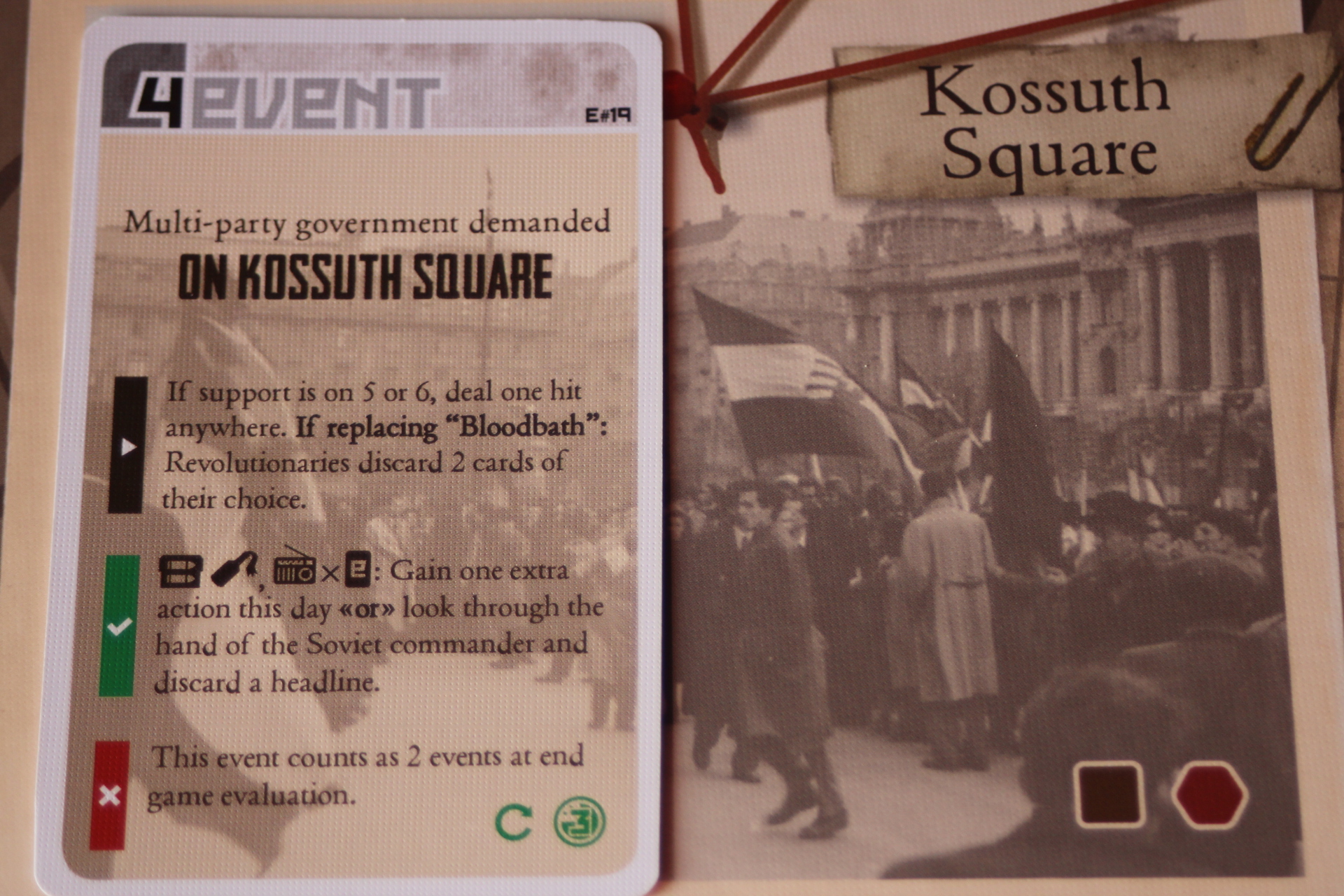
The Zhukov cards may also trigger events, some of which take place at specific locations in Budapest and are thus placed on the city map. These are the events that we, as revolutionaries, must resolve during the game. Furthermore, some events may be interlinked, affecting the successive outcomes.
One important feature is that some cards will shift support, towards the revolutionary side or towards the Soviet side, and the same goes with morale. Stuff to balance and to make play in our favour.
The four cards drawn at the beginning of each day will thus change the scene in Budapest, calling for swift tactical adjustments.
Another beautiful design detail: locations are represented on the map by white and black photos; event cards to be played on those locations have a background with exactly the same picture, thus maintaining visible all the photo, as if the playing instructions were merely superimposed.
Then, it is up to us!
As revolutionaries, we will be roaming across Budapest, recruiting fighters for the cause, combating militia and tanks, resolving events.
Our assets represented by cards, include movement (Transportation), the communication war (Newspapers, Information Leak), aid from the population (Aid, Food Supplies, First Aid Kit), weaponry (Molotov Cocktails, Pistol, PPSH-41), and street barricades (Build Barricades).
We will be activating and rallying fighters, for the revolution is not a single man combat, and relies, not only in numbers, but in complementary capacities as well.
The men and women that will join us are not anonymous people. They have names, may bring specific resources, and may have specific abilities. Important point: we need to first draw them into the cause and organise them in a team. You see, on the dawn of the 23rd, they are ready to fight, but are still waiting for a leader to follow.
Once engaging in the fight, they become targets for the militia and snipers, just as we are.
During the day we will be attempting to resolve the events unfolding at the various locations, by gathering and using resources, from our own stock – the cards -, and from the active fighters who are in place, or moving alongside us.
Students’ demands at the University of Technology. These came to be on the night from 22 to 23 October. Location: University. Required resources: food supplies (3) and communication to spread the news. Resources gathered: enough food supplies thanks to Imre Colos, and reliable news thanks to the newspapers. Outcome: a boost in popular support.
We will be engaging in combat against Militia
and Soviet Tanks deployed to the streets of Budapest. Yes, this is also a block-by-block
battle, with heavy guns, snipers, ambushes, and barricades.
Therefore, we need to have the right weapons and ammunition, at the right moment. And to always keep on the move, to avoid sniper attacks.
The targeting of Soviet tanks, cornered in the narrow streets, outside their natural operational environment, proves to be decisive, both in terms of moral increase as in terms of the Soviet decision-making.
This is a factor of paramount importance since high morale will grant you access to more assets, while an extreme drop in morale will inevitably lead to immediate defeat on the battleground and to the failure of the revolution.
The day will not come to an end without the action of the feared State Protection Agency.
In the solo and cooperative modes, this deck of SPA actions will be replaced by an automatic movement of militia, whenever they are in neighbouring locations to the revolutionary leader, and of snipers, always getting one step closer.
As a result, they will target revolutionary leaders, active revolutionary fighters, and barricades, eventually causing casualties on our side. Fighters will be shot down, as will leaders.
For gameplay purposes, leaders may eventually be healed, while fighters may not. Tough decisions lay ahead, when deciding on the deployment of our fighters and who may take a hit.
The cooperative mode adds some more layers into this experience, with the number of actions to perform each day being evenly split among the revolutionary players. Therefore, coordination becomes of paramount importance, in order to keep the revolutionaries safe, to gather the needed resources, to deal with multiple events, or to exchange assets.
The experience with the Conflict set of rules, with one player assuming the command of Soviet Forces, should prove to be even more distinctive.
Two extra decks of cards come into play, the headlines set (replacing the Zhukov set) and the SPA pool, with the Soviet player having to carefully weigh-in the options.
In order to gather and then trigger events, command points must be fristly collected. But for red cards, that would favour the Soviet side, this will be a one-or-the-other option: use the actions on the cards or collect command points. On the other hand, for the green cards, favouring the revolutionaries, command points are collected only when activating those cards. Afterwards, command points may be spent to obtain and trigger events across Budapest. Not easy to subdue a revolution.
Now, imagine, for a moment, that today is hétfő, Monday, 22 October 1956. It is night and you are at the University of Technology. The students are assembled and are discussing their demands. Tomorrow we will take to the streets!