24 February 2021

Days of Ire: Ep.4 - At the table


"Comrade Zhukov: Comrade Mikoyan is acting improperly, he's pushing us toward capitulation. We must insist on a firm position. Comrade Shepilov: the step was extreme, but correct. Real power is with the troops. To make further concessions would be regarded as weakness. Comrade Furtseva: Comrade Mikoyan, apparently, is mistaken about Nagy. They released 1,000 who had been arrested. Comrade Khrushchev: Mikoyan is acting as he said he would. Comrade Mikoyan supported a position of non-intervention, but our troops are there."
Working notes from the session of the CPSU CC Presidium, 26 october 1956


I open the box, remove and unfold the game board, a map of Budapest, laying it on the table. Then, I take the components and place them over the map: different sets of cards, two dice, counters in different shapes and colours - green rectangles, brown triangles and squares, red hexagons, orange octagons -, three transparent hemispheres, player tokens, circles bearing the words action, free movement, and inactive, black drops over red circles. Abstract components. Top-notch components and production from Mighty Boards, I may add.

Slowly, they start to change in meaning, pulling me back across space and time, towards Budapest 1956. 

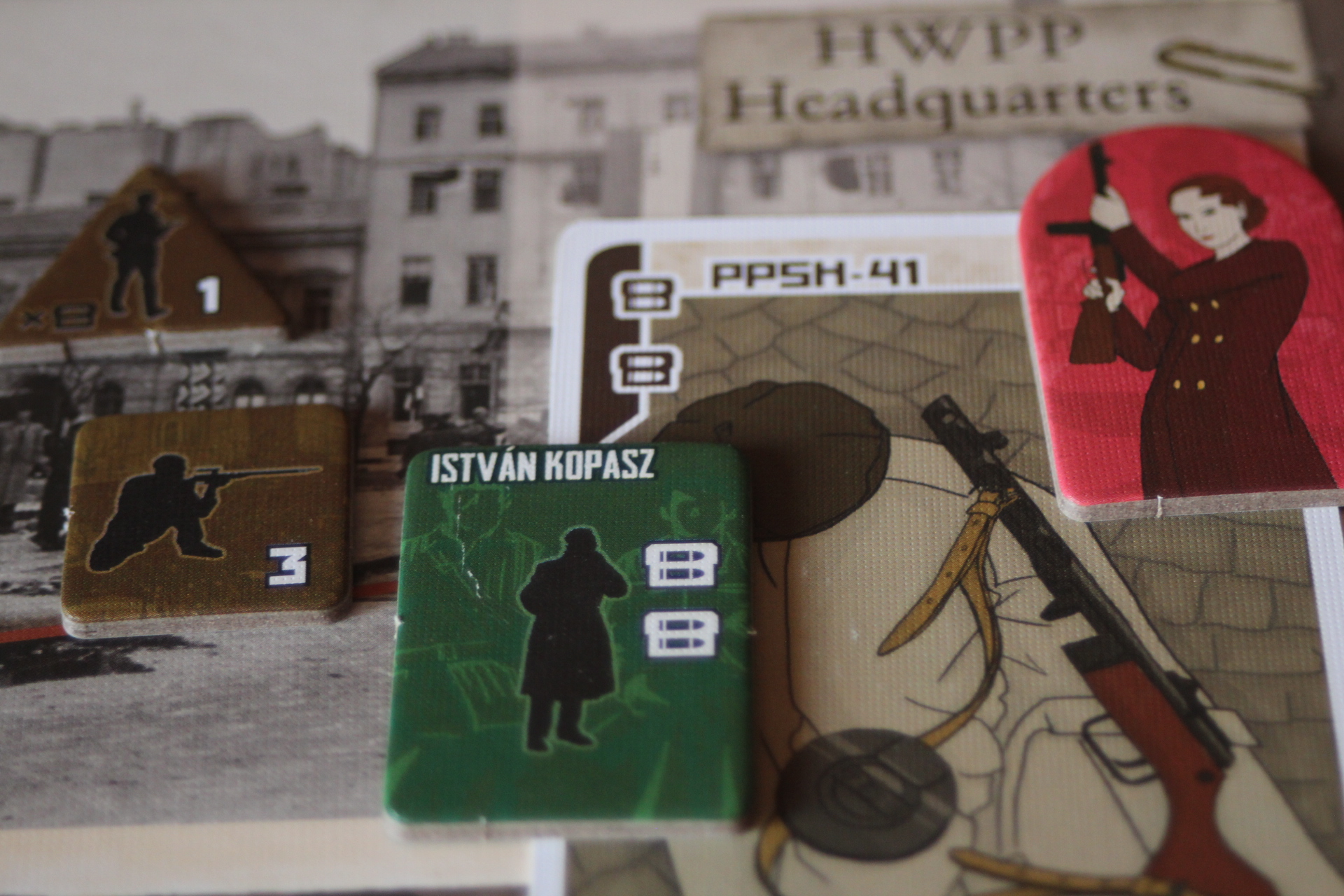
Black and white pictures on the board, portraying buildings, people, statues, armed forces. Decks of cards labelled as General Zhukov, State Protection Agency, Revolutionary Card, Day of the Revolution, Armed Uprising, The Turning Tide, or Event. Green rectangles with silhouettes of men and women, bearing names such as István Kopasz, and icons such as ammunition, Molotov cocktails, radios. The brown triangles and squares with soldier silhouettes, the red hexagons featuring armoured vehicles, the orange octagons showing barricades. The drops are, well, drops, blood drops.


In the box, not one, but three booklets. One with the same cover from the box: the woman holding a rifle in the left hand, the Hungarian flag stripped from the coat of arms in the right one; in the background, almost as a black and white picture were it not for the flames, soviet tanks are set ablaze, in a street battle; the red, white, and green from the flag, ever present in the graphic design, as a unifying element. A beautiful piece of art by Kwanchai Moriya. As the art of the Soviet cards, also authored by Kwanchai, the revolutionary cards by Katalin Nimmerfroh, and the graphic design by Sami Laakso.

This is the introductory booklet, containing a game overview, the setup for all three modes of play, an account of the revolution, and a set of appendixes with detailed information on all the cards and all the fighters. 

Then, there is the green booklet, the Zhukov ruleset, for the solo and cooperative game, where the player or players take the revolutionary side. 

The third one is the red booklet, the Conflict ruleset, where one of the players will take the side of the Soviet and State controlled forces. 

Booklets in red and green, nicely laid out, with room to breathe, clear instructions, and suitable examples. And with many small details enriching the playing experience and guiding the player in a journey throughout history and culture: black and white archive photos, history insights, and the phonetics of Hungarian names. 


The map of central Budapest, with the Danub river and the many bridges. Bem Statue and the University of Technology on one of its banks. On the other, Kossuth Square nearby the Parliament and Ministry buildings. Killian Barracks, the Corvin Passage, Corvin Theater. The Radio and the National Museum. Blaha Lujza Square and Stalin Square. Names and places still unfamiliar, waiting for us to venture into those streets.

A simple yet very efficient iconography indicates all you need to know for setting up initial forces, deploy reinforcements at the end of each day, keep track of support, morale, and calendar day. Coupled with the back page of the rulebook, holding a summary sheet, it provides an easy access to the basic information required for smooth play.


Tuesday, 23 October 1956. Tuesday, 30 October 1956. One single week. That was the time span from the beginning of the uprising to the ceasefire and withdrawal of the Soviet forces. Seven days. Seven rounds, one for each day, putting you to the test, with the conflict outcome to be assessed on the 30th.

To win, the revolutionary players must survive and hold morale, until the end of the game. But this will not be enough to be granted victory, as revolutionaries will be striving to resolve events unfolding all across the city. No more than four events must be left unresolved by 30 October! So, you will be also racing against time, as momentum is crucial in all revolutions, to rally both internal and external support. Victory may even be achieved earlier, should you be successful in repelling all militia and Soviet tanks out of the capital. 

Mind that Victory is not a steady and definitive state. The historical meaning in here being that the Soviet forces agreed to a ceasefire, facing the mounting casualties and pressure, withdrawing from the country, to return in force, just some days afterwards. But that is another chapter, another play.


Having only played it solo, this far, let us start with the Zhukov rules, in use for solo and cooperative modes. Zhukov, General Georgy Zhukov. We meet again! Last time, the battleground was Stalingrad, the winter was coming, and the fight for the city, against the German Armies, was intense. The game was Pavlov’s House, and the roles were quite different. Years later, in 1956, Zhukov was Minister of Defence of the Soviet Union and in command of the Soviet forces in Hungary. He will be our opponent.

Each day starts with the Soviet phase, driven by a specific deck of cards, the Zhukov set. Some cards will favour the revolution, while others will favour the Soviet side, depending on the card colour, the overall support level for the revolution, and the very day. Mind that support for an uprising is crucial to have any chance of success against military backed ruling power. 

Each card features three possible actions for three different periods of this week, the one to be triggered depending on the calendar day, thus accounting for the evolution of behind-the-scenes real elements that shaped those days.


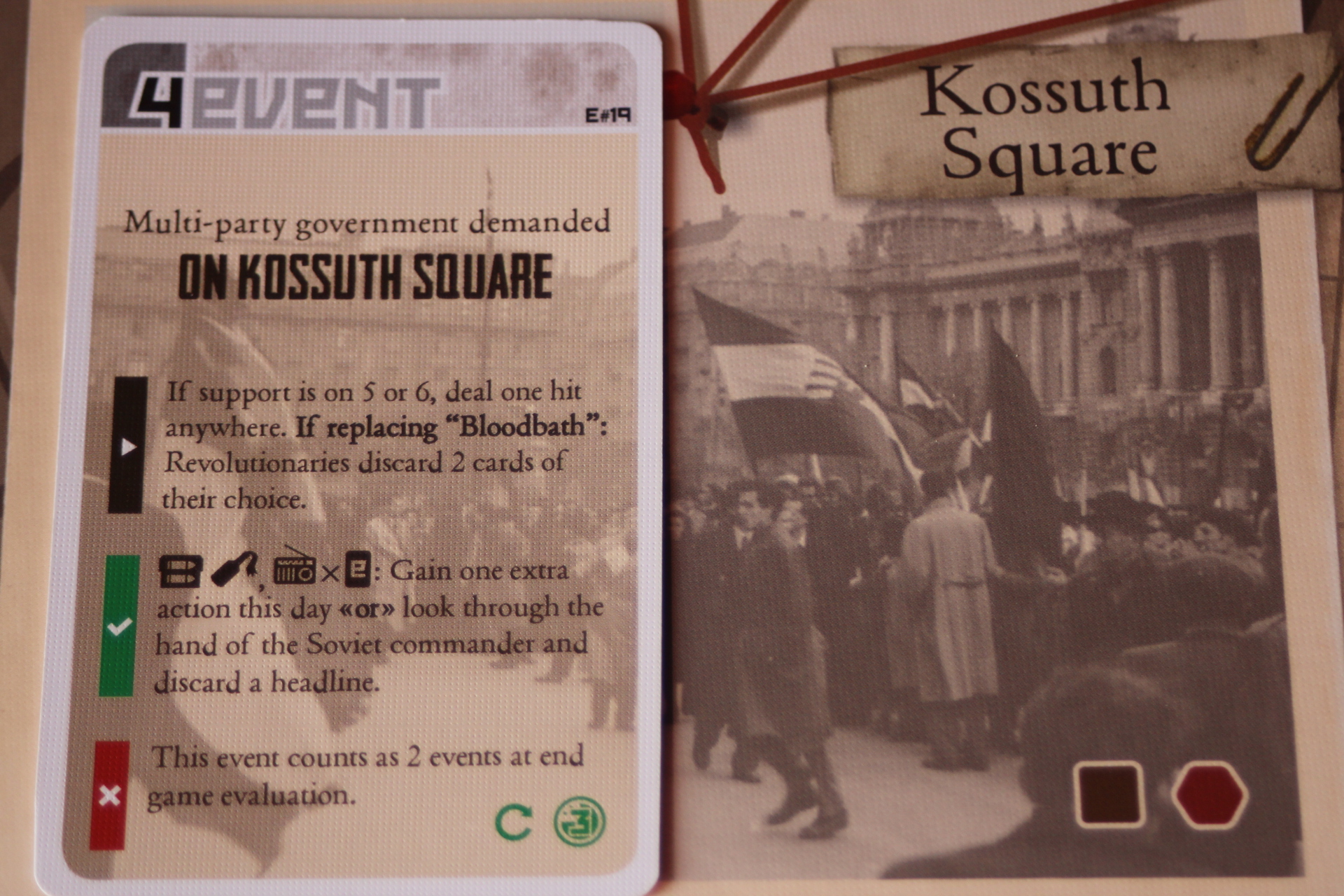
The Zhukov cards may also trigger events, some of which take place at specific locations in Budapest and are thus placed on the city map. These are the events that we, as revolutionaries, must resolve during the game. Furthermore, some events may be interlinked, affecting the successive outcomes. 

One important feature is that some cards will shift support, towards the revolutionary side or towards the Soviet side, and the same goes with morale. Stuff to balance and to make play in our favour.

The four cards drawn at the beginning of each day will thus change the scene in Budapest, calling for swift tactical adjustments.

Another beautiful design detail: locations are represented on the map by white and black photos; event cards to be played on those locations have a background with exactly the same picture, thus maintaining visible all the photo, as if the playing instructions were merely superimposed.


Then, it is up to us!

As revolutionaries, we will be roaming across Budapest, recruiting fighters for the cause, combating militia and tanks, resolving events. 

Our assets represented by cards, include movement (Transportation), the communication war (Newspapers, Information Leak), aid from the population (Aid, Food Supplies, First Aid Kit), weaponry (Molotov Cocktails, Pistol, PPSH-41), and street barricades (Build Barricades).


We will be activating and rallying fighters, for the revolution is not a single man combat, and relies, not only in numbers, but in complementary capacities as well.

The men and women that will join us are not anonymous people. They have names, may bring specific resources, and may have specific abilities. Important point: we need to first draw them into the cause and organise them in a team. You see, on the dawn of the 23rd, they are ready to fight, but are still waiting for a leader to follow. 

Once engaging in the fight, they become targets for the militia and snipers, just as we are.


During the day we will be attempting to resolve the events unfolding at the various locations, by gathering and using resources, from our own stock – the cards -, and from the active fighters who are in place, or moving alongside us. 

Students’ demands at the University of Technology.  These came to be on the night from 22 to 23 October. Location: University. Required resources: food supplies (3) and communication to spread the news. Resources gathered: enough food supplies thanks to Imre Colos, and reliable news thanks to the newspapers. Outcome: a boost in popular support.


We will be engaging in combat against Militia and Soviet Tanks deployed to the streets of Budapest. Yes, this is also a block-by-block battle, with heavy guns, snipers, ambushes, and barricades.


Therefore, we need to have the right weapons and ammunition, at the right moment. And to always keep on the move, to avoid sniper attacks.

The targeting of Soviet tanks, cornered in the narrow streets, outside their natural operational environment, proves to be decisive, both in terms of moral increase as in terms of the Soviet decision-making.


This is a factor of paramount importance since high morale will grant you access to more assets, while an extreme drop in morale will inevitably lead to immediate defeat on the battleground and to the failure of the revolution.


The day will not come to an end without the action of the feared State Protection Agency.

In the solo and cooperative modes, this deck of SPA actions will be replaced by an automatic movement of militia, whenever they are in neighbouring locations to the revolutionary leader, and of snipers, always getting one step closer.


As a result, they will target revolutionary leaders, active revolutionary fighters, and barricades, eventually causing casualties on our side. Fighters will be shot down, as will leaders. 

For gameplay purposes, leaders may eventually be healed, while fighters may not. Tough decisions lay ahead, when deciding on the deployment of our fighters and who may take a hit.


The cooperative mode adds some more layers into this experience, with the number of actions to perform each day being evenly split among the revolutionary players. Therefore, coordination becomes of paramount importance, in order to keep the revolutionaries safe, to gather the needed resources, to deal with multiple events, or to exchange assets.

The experience with the Conflict set of rules, with one player assuming the command of Soviet Forces, should prove to be even more distinctive.

Two extra decks of cards come into play, the headlines set (replacing the Zhukov set) and the SPA pool, with the Soviet player having to carefully weigh-in the options. 

In order to gather and then trigger events, command points must be fristly collected. But for red cards, that would favour the Soviet side, this will be a one-or-the-other option: use the actions on the cards or collect command points. On the other hand, for the green cards, favouring the revolutionaries, command points are collected only when activating those cards. Afterwards, command points may be spent to obtain and trigger events across Budapest. Not easy to subdue a revolution.


Now, imagine, for a moment, that today is hétfő, Monday, 22 October 1956. It is night and you are at the University of Technology. The students are assembled and are discussing their demands. Tomorrow we will take to the streets!


23 February 2021

Days of Ire: Ep.3 - Designer insights


"The Hungarian Tricolours without the Communist emblem, now flying on many public and other buildings throughout the city, while orderly crowds carrying their flags and singing patriotic songs are moving about at will. Without controlling the Government they appear to have come as close to controlling Budapest as is ever likely."
Leslie Fry, Confidential Telegram, Budapest to Foreign Office, 25 October 1956


We continue the conversation with Dávid Turczi, focusing now on the development of Days of Ire and the challenges of designing games that might echo individual stories and memories.

Are you fond of History subjects, at large, and History-based games?
I always enjoyed historical topics, especially ones I knew some stuff about, so I can feel smart and "put it all in context". Twilight Struggle and some good cold war thrillers particularly instilled a love of post-WWII history in me. 

I don't play "simulation" wargames, I don't do hex-and-counters, and I prefer my excitement to come down to more than a lot of die rolling. That said, a good, well developed historical theme that might teach me some stuff, has a good chance of drawing me in, and then making me read Wikipedia afterwards. 


What was the motivation to design a game based on the October Hungarian Revolution, and the will to honour those who stood up, back in 1956?
It was the 60th anniversary in 2016. Zsombor Zeöld, a friend of a friend, worked at the Hungarian Foreign Ministry, and suggested we design a game (with him consulting on the historical tidbits) and get some government grants to publish it. 

The grants fell through (bureaucracy 😜) but at that point we were too invested in the process to give up, so ended up publishing it with my Maltese friends at Mighty Boards (initially known as Cloud Island).


When approaching such a subject, do you find time distance matters?
I was probably the least historically inclined of the team. My job was to make the game tight and the strategies matter. Yet, we were not far enough to look at things objectively, I still heard stories of people who said the game invoked tragic memories from their childhood, but they thanked us for the approach, so I'm happy we did it right.


Did you already had a thorough knowledge of the events or was a lot learned during game development? How was the research carried out?
I learnt some basic stuff in high school, read a book or two, had some discussions with my dad over the years, but I'm definitely not an expert on the subject.  It was Zsombor's job to create "historical tidbits" we can use in the game, and Mihaly's to integrate it. 


I find the games about recreating history to be conceptually more demanding, as they need to strike a compromise between history and a balanced playable board game. Can you give us some insights into the process of defining what elements would be in the game (such as places, events, actions, mechanisms, characters)?
Initially it was filling in the "interesting stories" Zsombor had for us, and the momentous events. Towards the end, it turned around, I posed gameplay requirements that Zsombor tried to "find a story for". We just kept asking each other "is there anything else we should mention?"


In many conflict games units and individual characters are “anonymous”, in others they have fictional identities, and still in others, such as Pavlov’s House, they represent real people and bear real names. Why the option to name the revolutionary fighters in Days of Ire?
We wanted to create that personal feeling, so you feel bad when you sacrifice a fighter. From a mechanical perspective they are literally meat shields, to boost your hit points, but that's not how real people in real conflicts think. So, we gave them characteristics and a name, to make you connect with them - "Remember when Károly saved the day by bringing us more molotov cocktails?"...

That said we didn't want anyone's grandma to be in the game, so we went with "inspired by". Most characters were representing some noted rebel, or someone who did one notable act before disappearing from the stage of history, but we changed all the names out of respect for the dead and injured. 


The mechanisms and the rule set are much more streamlined than, say, the “classical” wargames I grew up with, with their hundreds of counters, lengthy rulebooks, and a concern about time and space scales. One could say it is more event-driven than a typical combat simulation. What was the feel you were aiming for?
The card play of the Soviet side was inspired by Twilight Struggle, while the Revolutionary side was meant to be a "heavy Pandemic" alternative. Definitely not what you'd expect in a wargame, our different background shows here. 


The game incorporates solo and co-op modes, playing as revolutionary, and competitive, where one player controls the soviet and state side. Was this intended from the very start, or have the different modes emerged along the way? 
We started with the competitive. The solo/coop was designed specifically to mimic the feel of playing the Hungarian side against a live opponent. 


The game includes archive photos, history background info, plus the nice little touch of providing the phonetic writing of Hungarian names, and a colour scheme based on the Hungarian flag. Were these options for keeping the theme ever present and to foster the curiosity about the events?
That was Zsombor's good influence on all of us 😊


How long was the game in the making?
We started in the summer of 2014, the game got to Kickstarter in 2016 if I remember correctly.  It was almost a self-publish, since Cloud Island was just one person and some extra help at the time (David Chircop, with whom I later worked together on Petrichor), so we briefed the graphic designer, the artist, proofing, everything. I learnt a lot about publishing process from this, from our own mistakes and ways we fixed them...


Why the follow-up with Nights of Fire?
Brian Train, the designer of A Distant Plain was a backer, and he mentioned that he designed a small tactical urban wargame about "the next week" of the soviet retribution. So, I asked him to co-design the sequel with me, and I married his tactical approach with my euro-inspired card play and low luck/high choice decision making.


Any project, in the design pipeline or just lurking, along this line of work?
I have a non-historical conflict game upcoming, Defence of Procyon III (shipping in a few months), which is a 2v2 wargame with minimal randomness, and 4 completely unique factions. 


Thank you so much for your availability and kindness, Dávid!


Now we know a little more about Dávid Turczi, the person behind this and other games, and we just scratched the surface of game design, teamwork and the complementarity of roles, the hardships of publishing, the influence of previous games and the links to games yet to be, and the connections that are established. 

Time to move on. Time to go inside the box!


22 February 2021

Days of Ire: Ep.2 - Meet Dávid Turczi

From Dávid Turczi's profile, in BoardGameGeek


“While fighting was in progress at the Radio Building, the first Soviet tanks made their appearance in Budapest at about 2 a.m. on 24 October, and were soon in action. However, no official announcement was made of the Soviet intervention until 9 a.m.”
Report of the Special Committee on the Problem of Hungary, UN General Assembly , 1957


The first time I heard about Dávid Turczi, and I will not be alone on this, was most probably something related to Anachrony. And for good reason: this game from 2017, which last year made its way into my collection, has been a smash hit! But it would be utterly unfair to centre his achievements on this game only, for Dávid is a prolific designer, and this is one among many, published or in the making.

To mention just a few of his creations, and following no particular criteria, you may have heard of Petrichor, Trickerion, Venice, Rome & Roll, Dice Settlers, Kitchen Rush, Rush. M.D.. If you often play solo, as I do, or if you enjoy to game solo while learning a game, it is very likely that you have already faced one of his solo modes, designed for an even greater diversity of games.
Courtesy of Ludocreations

If you dig a little more, you may find [redacted], from 2014, a game I have not heard before doing some research for this series. It may seem a long way back, but that was just seven years ago! Those were the beginnings, featuring the same designer trio as in Days of Ire: Budapest 1956: Katalin Nimmerfroh, Dávid Turczi, and Mihály Vincze.

In all, an impressive amount of work in just about half a dozen years, bringing many hours of entertainment, joy, and hard thinking, for so many.

My first contact with Dávid Turczi came in the form of a Facebook exchange: he was preparing to move and was selling a copy of Days of Ire! By that time, I knew a little more about Dávid than about Days of Ire, and because my wish list was already long enough, I passed on the occasion. Or so I thought, as my interest on this game kept growing, and something remained lurking beneath the surface! And last November I ended up ordering it. At the same time, the main idea and concept for a series of posts was starting to take shape.

Then, a thought crossed my mind: “Wouldn’t it be great to get some designer insights on the motivations and on the approach to this depiction of a very special period in Hungarian History, the history of his own country?”. After all, Days of Ire, as well as Nights of Fire, are two of a kind within his portfolio.

Would this be possible? Not personally knowing Dávid, I have formed the impression, from watching interviews, playthroughs, and casual messages in Facebook groups, that he remains a very accessible person, always keen to share his opinions in a passionate way. Furthermore, there were some hints of a soft stop for Days of Ire and for Nights of Fire, and a genuine desire to make these more well known.

So, why not try to arrange an interview? Worst case scenario: a no-reply. Second worst case: a plain no. Not much to lose! Upon a preliminary contact, I ended up sending my questions between Christmas and New Year’s Day (!), in line with an overall framework used for previous interviews: some organised and broken-down written questions for written answers, as writing is my media of choice. Well, in fact, there were not just “some” questions, but a bunch of them … maybe too many, I thought, requiring a fair amount of time from a busy designer for a small audience blog… 

One single follow-up check and a short wait later, it all came together! By mid-January, the questions were answered, not without an apology for having taken so long to reply, while dealing with a lot of work and additional interview requests!

So, let us meet Dávid Turczi, in his own words and smileys!
 

Dávid, please present yourself in short, well, as short or as long as you please, and focusing or not on the boardgame-related side.
Hi, I'm David Turczi, I'm roughly 33 years old, I was born in Hungary where I lived for 25 years, then after a ~7-year stint in the UK I now live in the Netherlands. I used to be a software engineer (the boring, business kind) but I quit 3 years ago, going full time design/development. My favourite music genre is 70s progressive rock, I always play yellow in board games, but most of my T-shirts are black. Spinach is the best vegetable side. 


Have you always been a board gamer? Could you share an early recollection?
I started in University, around 12-13 years ago. Some people were playing Bang! for fun, which then developed into all-nighter Munchkin sessions. It all took a turn for the serious when I got Battlestar Galactica: The Board Game as a gift (since my love for the show was well known). My First Essen Spiel was in 2012, where I bought 14 games, increasing my collection over four-fold.  


Physical boardgames, digital or both?
I started physical, then went digital, then went back to physical, and I haven't left since. 


How did the transition from gamer to game designer, and to publishable game designer, occur? 
The third expansion for BSG [Battle Star Galactica] came out too slow. So, I had to design my own expansion. And playtest it to perfection.

Then one day one member of my gaming group, Mihaly Vincze came home from a holiday saying "I designed a game!" I just couldn't help myself, I had to help him. Joined by my partner at the time Kate, the three of us spent months (years?) polishing the game. We pitched it unsuccessfully to a few others at Essen 2012, but in 2013 I met the man behind LudiCreations - a then just starting out Finnish publisher - and he signed the game. We learnt everything on the job, and the game came out. 

Suddenly, we were the "first internationally published Hungarian designers" so a Hungarian company that was about to launch approached us for "advice". That's how I met Viktor Peter and Richard Amann of Mindclash, I showed them a time travelling game (called Paradox Factory at the time), and then we went on a multi-year journey that ended with Anachrony getting published and making me famous overnight 😊

First I got lucky, and then I worked for it 😊


Any lessons, thoughts, or stumbles, along the way you may want to share?
Be polite, adapt to others, but be shameless to show off what you're good at. 
Nobody cares what you can do if they don't know about it...


As a well-known designer, do you feel the pressure to “deliver”, and eventually to “compromise”, or do you feel you have now more freedom to pursue your own ideas?
I have a lot more freedom now. I don't have to come up with a game, spend months polishing it, set up 10 meetings, and then get rejected 11 times before somebody somewhere wants what I have (but needs me to work months more for it first). 

I just evaluate my idea (or as others would call it - take a shower), and then decide which publisher I want to call. I set up a meeting, I explain the idea, and if they like it, then I spend a few weeks creating a proof of concept, and then show that to them in a second, pitch meeting. Then I take onboard all their ideas, criticism, etc, but if the original idea was good, at this point they'll sign it probably, and from then on, it's all our problem. 

This means my bad ideas get shot down faster, my good ideas get improved sooner. And fame brings access to volunteers, which means I can get more done, with more hands. Sure, I need to compromise, and not "build my precious baby" each time, but that's just good common sense, cause designer eccentricities tend to make the game (even heavy euros I tend to work on these days) hard to publish.


Is there a typical day, as a full-time designer?
Alarm goes off at 8.25, read news, crawl to the bathroom, sit in front of my laptop by 9.30. 

If it's a meeting day, then probably be on google meets from 10 to sleep time (with a few breaks for lunch, my girlfriend arriving home, dinner, cat petting, etc). 

If it's a prototyping day then pop on some scifi series I've seen a hundred times and chop away at it with the printer, the scissors, and the cardboard. 

If it's a playtest day, then welcome playtesters between 10 am and noon, and then play games with them until six in the evening, in the company of some good takeaway food 😊

And then cycle through this, 5 to 7 days a week 😊


Which one fits you best, concerning game design and the development process: obsessively organised, organised, organised chaos, or plainly chaotic?
Organised chaos. I have a to-do list with priorities, I have a slack for each publisher, I have organized dropbox folders, and I have a google calendar strictly filled with not-to-miss meetings. But what happens in-between is magic, madness, and the will of the universe.


And now some quick questions about games you enjoy playing.

An “oldie” that sticks to your memory or that you even play now and then.
I don't play anything "that old" 😊 But games that are past the "hype of the new", I'd say Glory to Rome is still the best, other notable mentions to Caylus, Among the Stars, Eminent Domain.

An history themed game of your liking.
Sekigahara.
Imperial Struggle.
1960: The making of the President.

A solo game/mode that you enjoy, designed by someone else.
I never play solo.

The very last game you played.
Excluding playtests, it was Dawn of Peacemakers from Sami Laakso, a reverse-wargame wrapped in a lightish coop game. My last "crunchy euro" was Kanban EV, from Vital Lacerda.

A game that you are looking forward to playing soon.
I'm due to play the new version of Martin Wallace's Tinner's Trail, and I'm curious 😊


There is more to come from Dávid, as we turn the conversation into the design of Days of Ire, in the next episode.


21 February 2021

Days of Ire: Ep.1 - Serious stuff


"As a second year student at the Technical University in Budapest in October 1956, I worked for the Revolutionary Student Committee in the student dormitory where I lived. I also became a member of the National Guard. Though I was not a freedom fighter, like so many others, I also had remarkable experiences which rekindle uplifting memories on the 60th anniversary of the Hungarian Revolution."
Gyula Várallyay, Hungarian Review, Vol. XI., n.º 6, January 2017.


This is the first episode in a mini-series on the boardgame Days of Ire: Budapest 1956. Why a set of episodes, you may wonder? Well, as there are different angles to share, one single post would either be way too long for nowadays standards or would provide insufficient coverage. So, this a compromise, allowing readers to embark and to leave this journey at will, to retrace to previous content, or to engage in their own explorations, while maintaining a proper pace and sequence.

7 days, 7 posts, covering the game itself, how it ended up in my collection, some side stories, designer insights, gameplay, and the underlying History.

Those who have been following this blog may notice this is, in fact, the second series. In late 2019, inspired by the components and mechanisms of the boardgame Newton, and by readings on the history of higher education, I travelled across the Europe of the late 17th century. The resulting Quest for Knowledge is a ten-episodes short fictional work, a first-person travel account, mixing glimpses of History with elements of the game, hence a very different take.

It is now time to put on some sturdy boots, jump back in time to 1956, and hit the streets of Budapest, the Hungarian capital. Our guides for the journey will be three Hungarian game designers, Mihály Vincze, Dávid Turczi, and Katalin Nimmerfroh, inspired by the events which took place from 23 to 30 October that year, a popular uprising against the soviet-backed ruling power, which became known as the October Hungarian Revolution.

Days of Ire: Budapest 1956 was originally published in 2016, precisely 60 years after the Revolution. In the game, you may choose to take part on the revolution, either solo or cooperatively with fellow revolutionary players, facing a virtual opponent. Or you may choose to engage in a 2-sided confrontation, where revolutionary players will face a single player in command of state and soviet forces, seeking to suppress the revolution and reinstate state control.

This is a game about conflict. It is a game rooted in History, based on real events lived by real people, not that far away in time. Events with dire consequences for those involved: injury and death, imprisonment, exile. Events whose consequences for the Hungarian society and abroad had long-lasting and far-reaching repercussions on both sides of the Iron Curtain.


This is serious stuff. 

And gaming about serious stuff might be controversial.

After all, “to play” is most often associated to feelings of joy, even if tempered with some competition and mild conflict, and not with suffering and destruction. The very concept and rise of the so-called Eurogames is deeply rooted on an intentional move away from game elements such as open direct conflict, opponent targeting, and player elimination, coupled with increased importance of process over theme. 

And yet, there is a long-standing stream of wargames and other conflict games, simulating, or recreating, struggles, fights, and wars, over time. Furthermore, such games often allow players to take an active stance on different sides of the conflict. This genre of games will not appeal to everyone, and that is Ok! Just the same as military history books, war movies, and alike. Some players may treat these as any other games, in a sort of an abstract way, seeing only tokens and abilities to be used in the pursuit of victory, without any immersion whatsoever. And that is also Ok! People seek different sorts of experiences at the game table, considering their own preferences and perspectives, the playing group, and even the moment. 

These considerations could be extended to a much broader range of games, having in common themes that have affected, or are still affecting, the lives of others and maybe even our own lives. Some examples involving different kinds of decision-making (that I know of, but have not played yet) are: This Guilty Land, dealing with the political struggle over slavery prior to the American Civil War, putting face to face Justice and Oppression; This War of Mine, where you are a civilian making the best to survive in a city ravaged by war, with a range of associated moral dilemmas; Article 27, bringing to the table national agendas, common agendas, and the trade-offs of international policy making, with the UN Security Council as setting; The Cost, about running the asbestos’ industry, with workforce deaths factored in; Healthy Heart Hospital, and the health care management. Many economy-based games, where maximum profit is the ultimate goal, or those dealing with national expansion and colonisation themes, could be added to this list.

For more on this, you may read, among others, “Designing for Difficult Subjects”, by Chris Bennett, from the The Game Design Thinking Research Group, Stanford University.


So, what is my take on all this?

Well, wargames were probably the very first complex games I played, in my teens, way back in the late 1970’s-early 1980’s. With scenarios mainly set in WWII, and titles such as Panzerblitz, Air Force, Operation Barbarossa, and, later, Squad Leader. In plus, there were some attempts at wargames with miniatures. And other conflict games as well, as Diplomacy, the most stressful game I ever played (apart from competition chess, but that is another ball), vying for supremacy in a pre-WWI Europe, negotiating openly and in restricted groups, making alliances, eventually breaking them while deciding movements in secret, along four or more hours of play.

As for the appeal? I find that it comes in layers, or in waves. 

There is the underlying history context, unfolding at your table, with events being recreated while incorporating your own decisions. A sort of passive-active dilemma, being both an observer and an actor, trying out what-ifs, understanding real-life outcomes, so often making winning or losing a secondary factor.

Then, there is the simulation side, that feeling that those places are real, as real are the characters and abilities, factor movements and ranges, equipment and weaponry. All these elements, in greater or lesser detail, exist, or have existed. They are a product of detailed research rather than of imagination, extending your reality.

In terms of game play, there is strategy and tactics, organizing and deploying units, factoring in their specific characteristics, the terrain, the weather, the availability or not of reinforcements, the ticking clock, the chains of events. These are usually asymmetric games in nature, as there are no real level playing fields. And you may experience it from different perspectives, different sides of the battlefield. The objectives may be manifold, as keeping foot on a stronghold, surviving time enough to the arrival of reinforcements, capturing a hill, protecting a bridge, ensuring supply routes, delaying the opponent. And, accordingly, there is a palette, or a gradation, of winning conditions, including partial wins and defeats. This is rarely about checkmating your opponent. 

Furthermore, these games feature complex patterns of incertitude, not randomness, related to the unknowns, the fog of war, the shifting morale of your units, even political events occurring outside the board.

Granted, these are stripped-down versions of actual conflicts and wars, seen mainly from a HQ perspective, in 3rd person – well, you may come down to individual characters, with their unique features, in small scale tactical and campaign games - with no civilians around, no lasting impact on those at war, and to be played in the comfort of your living room. And you will go back in time again and again, relieving it, repeating the experience, acquiring and using new knowledge, as if moving in parallel worlds, instead of the real one, where you would have only one shot, one opportunity, a tiny distance lying between life, harm, and death.

These are just some musings from a long-time gamer. Each player will have a unique approach to a game, to these games, just as different people will take away different things from the same books, movies, or music, and will surely experience feelings and emotions quite different from those experienced by their authors.


Days of Ire is not a hex and counter simulation, full of combat and movement charts. It is a rather more fluid creature, where movement, resource management, capabilities activation, and timing, are of paramount importance, in this street conflict of David against Golias. 

Why is this so? What was factored in and what was set aside? 

Well, games are imagined and created by real people, with their own history, perspectives, preferences, motivations, and approaches. What better than to meet a designer, become a little bit more familiar with his work, and learn first-hand about all this, up close and personal?

Join me tomorrow for Episode 2!


18 January 2021

18 Days


18 days, 13 games, 38 matches, 2 common denominators.

18 days, between mid-December and early January, with a Christmas holiday in between, family gatherings, and the appropriate protection measures of these silent twenties. Time to have more players around, time to play more.

13 games of various types, shapes, and forms. Abstract or themed. Short or longer in duration.  Mostly at two player count, but also at three, and in larger teams.

38 matches, not least because there are games that immediately demand for a rematch.

2 common denominators: all of those were played in family; Leonor was a partner in all the thirty-eight.


Codenames Duet and Codenames. The most played ones. These are the kind of games almost impossible to play just once! Very accessible to everyone who likes playing with words and with their meanings. Searching for more obvious or more unlikely associations, providing far-fetched clues that we trust our partner or team will understand, seeking to avoid misleading ones that could point to words of the opponent, or even worse, to the word where the assassin hides. 

At two in the Duet version, the first one entering our home. At 10 players and three generations, in the competitive version between two teams, in a race always tense, in which it is not always easy to resist giving away, or looking for, non-verbal clues! And, furthermore, for the very first time, we experienced a game with a double agent, at 3-player count.


Sagrada e Azul. Two games featuring regularly at our table, or on other tables. Very pleasant, at touch and sight. Tasting as an abstract puzzle, almost like a solo game, were it not for the shared pieces.
It is always a challenge to efficiently fill-in our own stained-glass window of the Sagrada Familia. Placing the colored dice according to the restrictions of our base, avoiding adjacent dice of the same color or of the same value, attempting combinations that earn you points, surgically using some tools to mitigate the effect of luck, trying to keep the options open for the final stages, those in which free space in the stained-glass is scarce. And then, there's always that person who first gets the dice so badly wanted... 

Likewise, it is very appealing to build our mosaic of Portuguese tiles. More tactical at 2-player count, plays equally well at three or four players, while requiring a somewhat different approach. Go for columns, rows, or sets of tiles.  Go for adjacent placements to immediately earn some points. Avoid wasting tiles. Choose carefully between those in one of the factories and those of the common area. Watch the opponents' panels, playing with the timing of your choices.

Find out some more about Sagrada and Azul on this blog.


Keltis. This one, having 2008 as publishing date, has been around here for some time. But I just cannot get enough of it, and even though it is, deep down, a race, I even find it to be relaxing. 

It is a pleasant combination of five routes, to be walked through with our stones, the movement being based on the placement of cards of the suit corresponding to each route, in ascending or descending order. With a few more bonuses along the way, enabling to walk faster, to get some points, or to collect gems, you need to manage the chance associated with the card drafting, timing the advance on each route. To spice things up a little more, the moment where the game ends is not fixed, depending on the turn when enough stones reach the most advanced ranks of the paths.

Find more in here.


Heaven & Ale. Becoming ever increasingly fond of this game of monk brewers, full of difficult choices!

An area for growing products, half in the shade and half in sun, in which the products planted in the former may be sold for cash, whereas those in the later will improve the quality of our crafted beer. Five different ingredients, requiring a balanced mix each with a palette of values: water, wood, hop, barley, and yeast. Monks to go out work in the fields. A master brewer who must evolve throughout the game, or else we will not obtain a tasty beer. Limited actions and resources.

Will I choose to get some wood, to recruit a monk, or to trigger a special action? Those I will not choose right way will most probably be picked by some of the other players … Place in the sun or in the shade, quality or money? Still have that feeling of not having played it times enough to be sure of what I am doing around.

And there is more to get on the table: the expansion Kegs & More, adding cartwheels, inns, and the distribution of beer, one of the games I translated to Portuguese.


Takenoko. The Panda and the Gardener arrived here during the first lockdown. A colorful and bustling invasion, with an expanding terrain of large hexagons, the need to irrigate the land, and the bamboo sprouts, first planted, then growing, and, from time to time, eaten by the hungry creature. Plus, some dice rolls, bringing some unpredictability turn after turn. The objective cards for punctuation seem somewhat unbalanced, but that is something to be checked later, and it does not spoil the entertainment. Always fun! 


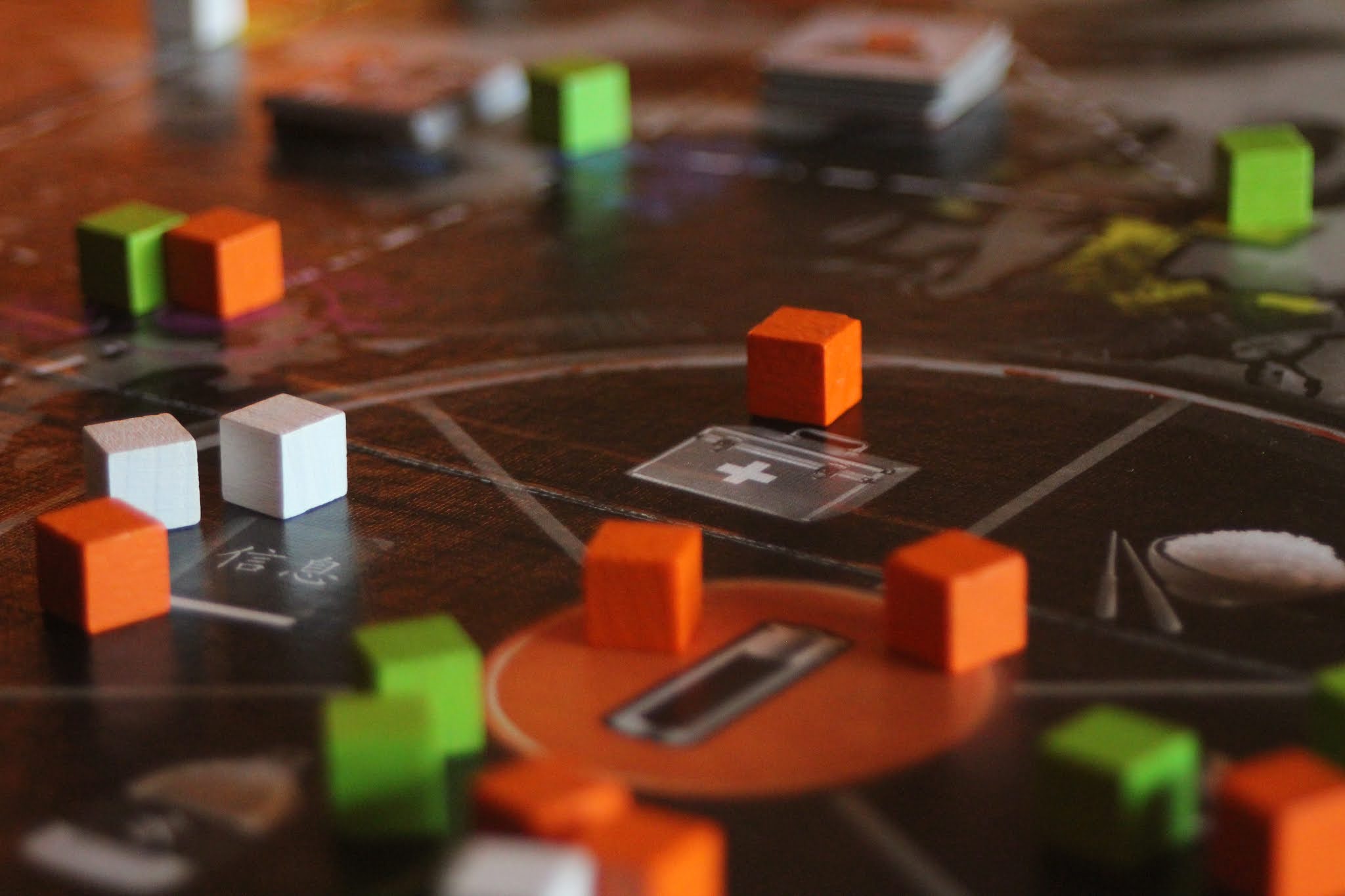
Blackout Hong Kong. A game that I am still discovering, at a slower pace than Leonor, or so it seems! With the underlying theme to reset the electricity in the districts of a Hong Kong plunged in darkness, it is my first contact with the games of Alexander Pfister.

This is a game of resource management and fulfillment of objectives. Management of our intervention team, with elements with different individual abilities. Time management, because the team elements deployed will not be readily available again. Management of resources, necessary to fulfilling the various objectives, to extend our range of action, and to improve our own capabilities. Risk management, since the exploitation of unsafe areas, essential to make progress, inevitably cause some casualties that end up in the hospital.

An excellent combination of elements and diversified game processes, which are not hard to assimilate in a pair of games. That is what we did, going for a second round, soon after the first learning play was over. A game to play more often, with the advantage of having a solo campaign variant, although without a virtual opponent. 


Concordia. An excellent game, with extremely simple and very elegant rules, based primarily on the use of action cards, and yet with a deep underlying strategy.

Expanding our influence and producing goods in the Italian peninsula or around the Mediterranean Sea, aiming high, the Roman way. Building cities, sending our settlers by land or sea, producing fabric, wine, tools, bricks, or food. Using Diplomats, Senators, Tribunes, Traders, Architects, Specialists of different crafts.

This is another game I really need to play more often, and another one where I must attempt to shorten distances to my gaming partner’s scores! As in Blackout Hong Kong, these are games requiring some more time to play, especially at higher player counts. Nevertheless, it is time well spent!

Still to try out, the Venus expansion, another one I translated.


Solenia. Another game that I am very fond of, because of the beauty of Vincent Dutrait's art, and the gaming originality, conferred, above all, by the continuously moving board, alternating between day and night, just as in a planet in rotation.

Collecting resources from the production zones where it is always day, to deliver them to cities where it is always night, and vice versa. This is our mission, as described in here.

With simple, advanced, and solo rules, the exploration of Solenia continues. Think I will really have to paint that yellow plastic ship, to better match the remaining components.


Rossio. Always special to return (strange verb to use for a game released in 2020) to this game designed by Orlando Sá. This is because I had the opportunity to test it as a prototype, during the final stages of development, at two and three players, and in particular soloing against Ross, the bot.

With another Portuguese theme, the author's brand image, Rossio has an original scoring system. The pavement being built is truly a public space, not belonging to any of the players, and where every and each one can score the patterns that are being made. This implies that, with good planning, points collected in each turn will be increasing throughout the game, with most of the points for grab depending on the last few rounds.

See more about Rossio.


Railroad Ink – Deep Blue. Another puzzle-like game, this time a truly individual one, in which the options of each player do not have any effect whatsoever in the game being played by the others. And yet, it feels good to play it together! A game with a taste of summer, with the refreshing blue shades of this version, and perhaps also by having played it firstly in the past summer holidays.

All you have to do is roll the dice and trace roads and railways, intersections and multimodal connections, rivers and lakes, to obtain more points, or to suit your imagination.


Holmes: Sherlock & Mycroft. A game just for two, which I haven’t played in a while. The theme of the investigations of the famous detective serves as a backdrop, with its array of characters with their own characteristics. As for the theme, this is just about it, as you will be competing to get more clues (cards) in each or some of the sets (suits) than your opponent. No mysteries to unravel, but a fight for majorities bearing different values.

This is a fast-paced game, with a fixed number of turns. It has variability, from game to game, since most of the characters will enter the scene in a random order, with their abilities becoming available at different times and in different combinations. Plus, being very compact with a small board and a small box, it can be taken anywhere.

1 January 2021

Six Pack - N.º 6 - On the Box

The Castles of Burgundy

Six.

The sides of a dice.

The sides of the hexagon.

Photographs without comments.

Gathered together under a common feature.


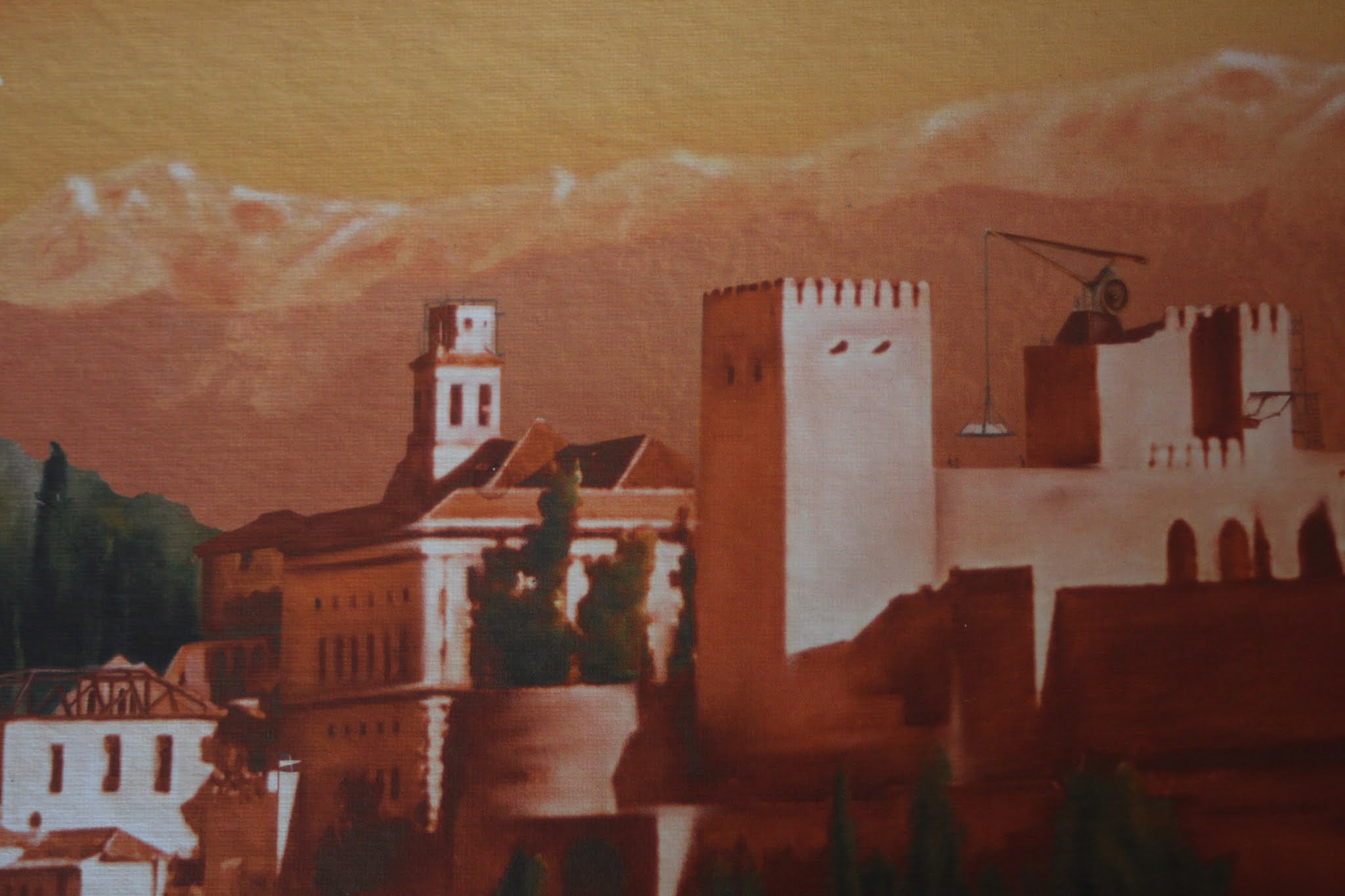
Alhambra


Yangtze


Solenia


Tsuro


CO2 - Second Chance

29 November 2020

Handmade


To play and to make games. 

It has always run in the family. 

Since the era b.c., before Catan.

Well before the other era b.c., before the Computer.

Where so often the best was to make use of markers and crayons, scissors, glue, and even wooden bits. Not forgetting the typewriter, printing letters in black and red, to give the rules a polished look.

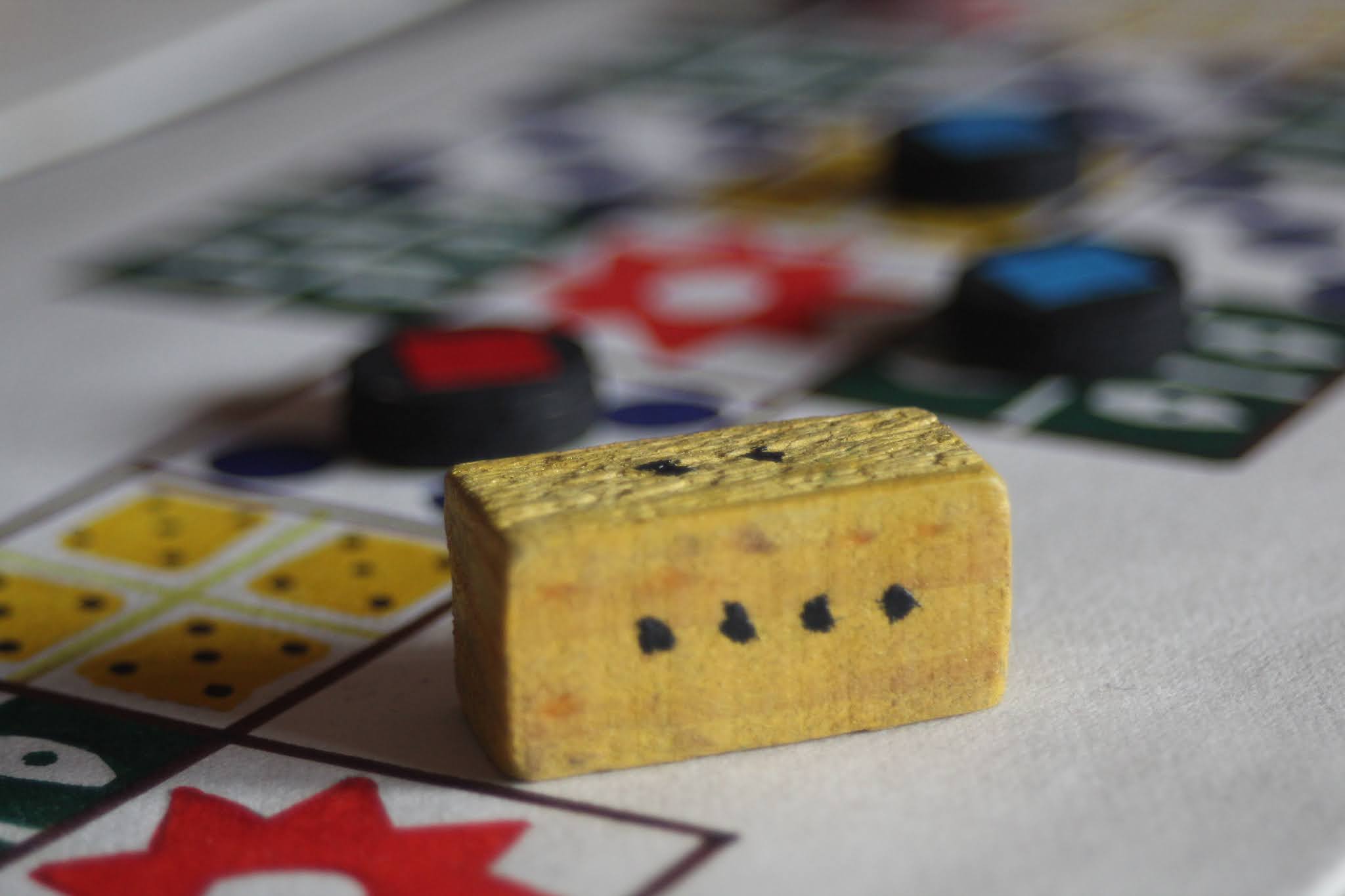
The Game of the King of Ur and the Palm Tree Game, rooted in the history of civilizations, here recreated by my sister, sometime in the 1970's.


Definições de mensagens Etiquetas Família, Jogo do Rei de Ur, Jogo da Palmeira Sem sugestões correspondentes Publicado em 29/11/20 11:15 Link permanente Localização Opções Mensagem: editar