11 January 2025

Notes from an exhibition - Timeless strategy classics


Long before the age of cardboard and printing, games were played on boards made of wood or more valuable materials and used stones, beads, seeds, or carved figures. These were times primarily for abstract games, confronting two opponents in duels of the mind. What they had in common was a simplicity of rules that can be learned in minutes, but allowing for deep strategies and refined tactics that take years to master.  


Go. I discovered it in the 1980s, thanks to the French magazine Jeux & Stratégie. I was fascinated by this ancient oriental game with a minimalist, black-and-white aesthetic. A considerable board, with nineteen by nineteen intersections, starts the game completely empty. Total freedom. The stones are placed alternately, but they no longer move once placed. Pressuring territories, conceding others. Between short-term gains and lasting influences. Action and passivity. Space and time intertwined. With its own language, which sounds exotic to Western ears, long before manga and anime became widespread. Joseki, Ko, Tesuji, Atari!


Mancala. Sow first, to then reap in a circular movement between the spaces on our side of the board and our opponent's. Picking up seeds on our side and distributing them, one by one, to the following spaces, often stopping on the opposite side and even going around the board more than once. It appeals to the senses, between handling the seeds and their characteristic sound hitting the wooden concavities or other seeds. It's a game of complex calculations, especially for those used to more linear thinking, but it's exciting nonetheless. And a concept that you may find in many recent board games.


Chess. It's undoubtedly the game I've played most often, undoubtedly because I've practiced it competitively for many years! I'll leave you with a free translation of the words of Joel Lautier, Grand Master of the sport, in the Larousse du Jeux d'Échecs: ‘What does the game of chess mean to those who play it assiduously? (...) For my part, I would answer the curious but hasty questioner that, for the competitive player that I am, it is a game in substance but a sport in form. If he has more time, I'll tell him about the rigor of the preparation before the game, the intense concentration needed to accurately calculate the variants, the deep aesthetic joy of a combination that reveals itself, the absolute self-control required at the critical moment when the fate of the game swings, and the patience needed to break down the opponent's last defenses one by one. If he becomes my confidant, I'll also tell him about the anguish of the fight, about those terrible defeats that are like so many little deaths in the precise moment.’

2 January 2025

Notes from an exhibition - Words and Cards


Of words and cards. Familiar elements, extremely portable, requiring little space or even no table. No wonder they form part of so many games and are even the main, if not the only, ingredient in many. With a long history as play elements, they are still constantly reinvented, building bridges between old habits and new experiences.

Codenames. To play in two teams, combining deduction, strategy, and the knowledge of the partners. Associate ideas, give a single word as a clue to discover several in the grid, hoping the partners are on the same page. But it turns out that only some of the words correspond to our spies, others to those of the opponents, still others to innocent civilians, and one is the assassin, to be avoided at all costs. A game for everyone by Vlaada Chvátil, celebrating a decade of existence and well-deserved success.


Just One. Another variation in word guessing. There is just one team, and the aim is to get one of the players to answer correctly. The problem is that each remaining player chooses a clue word in secret, and identical clues are eliminated! What is the best strategy: to go for the obvious and risk the elimination of clues, or search for more elaborate clues, but which may need others to convey the intended meaning? A game from Ludovic Roudy and Bruno Sautter.


Scrabble. A true classic, created by Alfred Butts in the first half of the last century. Building words, letter by letter, in a dynamic crossword puzzle. But with a scoring system that rewards the strategy of occupying the space and the quest to reach bonus squares that double or triple the score of the letter placed there or of the whole word using that space. It was played as recently as yesterday, in a true example of games accessible to players over 90!


The Crew - The quest for planet nine. A reinvention of trick-taking games in a cooperative format, with missions to complete as a team, but hindered by minimal communication. Win a trick with the lowest card? Winning certain cards in a specific sequence and by predefined players? All this, and much more, is in this game by Thomas Sing.

Arboretum. It combines the placement of tree cards to create paths of the same species in our individual arboretum, with the control of each species using the cards left in hand at the end of the game. Guaranteed dilemma: to play a card to extend the paths or keep it in hand to vie for control. An original game by Dan Cassar, with beautiful illustrations by Philippe Guérin, Chris Quilliams, and Beth Sobel.

Whales Destroying the World. Bluff is king in this game of hidden roles and unusual name, where you don't initially know the identities of allies and opponents. This was my first collaboration in the world of board games, translating the rules into Portuguese when the game was searching for funding on Kickstarter.


Magic the Gathering. It is one of the card games with an unusual notoriety status. A duel in magical worlds, using cards with their names and powers. Its mechanics promote a high level of interaction, allowing you to activate cards, attack, defend, counterattack, increase or interrupt effects, and even interrupt the interruptions themselves. Fuelled by a continuous edition of new cards and sets, it allows you to build customized decks to your own taste, knowledge, and wallet. Strategising before and during the game. Playing in tournaments. Collecting the cards. It is hard to believe Richard Garfield's idea is thirty years old!


Traditional cards. Poker. Tarot. Decks of different sizes and composition. A multitude of games for all tastes, handed down orally, collated in magazines and books, available on the internet. With regional or national variants. Fitting in a pocket. Without text, facilitating global sharing. They can even be used for magic tricks or complex hand manipulations, should you have the skills!

14 December 2024

Notes from an exhibition - The games leave the flatland!


Game boards and cardboard pieces are common components of many games, evoking the flats of a life in two dimensions. But it does not have to be that way. Neither in games that use  boards as an essential part, nor in those that are played on a table but without a board. Examples abound, spanning decades.


Um para todos. One for everyone. A game that already featured in the blog. A matter of balance, always in a critical condition. Choosing between safer or riskier positions. Trying to condition your opponents' choices. And, when disaster strikes, picking up all the fallen clowns. Created in the early 1970s by Theo and Ora Coster, founders of Theora Design, Israel. 


Quarto. One of the many derivations of Tic-Tac-Toe. Quarto because the line-up consists of four elements. But with many layers, since each piece has four attributes: light or dark colour, short or tall, with circular or quadrangular base, hollow or full. With an added detail: you are the one who chooses the piece your opponent will place! A game by Blaise Muller (1991).


Tokyo Highway. The game that aroused the most curiosity in visitors, no doubt about that! An installation of sober shapes and colours, punctuated by colourful small cars. How is this played, people asked? It is a mixture of strategy and dexterity. Building your own road, with segments of the same same size and never flat. Building pillars so that you can build overpasses and underpasses, crossing the roads that have already been laid out. Avoiding obstacles. By Naotaka Shimamoto and Yoshiaki Tomioka (2018).


Santorini. In shades of white and blue, the eye-catching image of the Greek island bearing the name, borrowed by this boardgame. The island takes shape as the buildings are erected. First, we move one of our builders. Then, we place a floor of a house, building one floor at a time, to be topped with a blue dome. The aim: to be the first to reach the top. With the possibility of playing the role of mythological figures, each with their own power. An invention by Gord! (2016).


Photosynthesis. A game of light and shadows, literally. With the Sun rotating around the board, the trees growing, releasing their seeds, and casting shadows, which prevent other trees from growing. A constant struggle, anticipating the next Sun rotation, attempting to secure space, aiming to make the trees grow, and then cutting them down. Find out more, here. A dream by Hjalmar Hach (2017) with the art of Sabrina Miramon.

11 December 2024

Notes from an exhibition - The preparation


First, a reconnaissance tour of the venue. Then came the measurements and sketches, numbers and shapes. Two triple display units with drawers, seven vertical units with four shelves each, five cubes, and two large tables with glass tops. Lengths, widths, and heights. Imposing limits for the games to be displayed, or, more appropriately, parts of games. Yes, because some games require a lot of space to be seen in their entirety, or to be played; others even develop in three dimensions.

The process evolved intertwined: the arrangement of the displays within the exhibition room, the themes for the modules, the choice of games, and the configuration of each game. Each part influences the others. Blueprints were drawn on the computer, represented on cardboard over the table, and mapped on the floor. Boxes were opened, and components scrutinized. Games were assembled and disassembled, their presence in the exhibition room imagined. Photographing alternatives for selection and to guide the on-site assembly. A construction site at home.

Themes and games. The games leave the flatland! Words and cards, raw material for games. Timeless strategy classics. Boardgames intersecting literature, cinema, and digital games. Agents of change. Books and miniatures. Oil, CO2, and knowledge. The development of a game. What game am I? Cloud of words.

Then, I had to think of several other elements: a slide show to support the opening and to be viewed by visitors, informative texts, posters and leaflets, content for web pages, and a list of insurance purposes. Fortunately, I could rely on Margarida's expertise to make up for my lack of experience in the field, and on the team from the University’s Library to produce materials and for the installation.

Not to be forgotten on the to-do list was the timely invitation to a North American game designer for a long-distance conversation and the preparation required as a facilitator, revisiting games, former interviews, and texts. 

Time was running out, but the exhibition was taking shape!

4 December 2024

Notes from an exhibition - The concept


Eighteen months had passed since the invitation, amidst those strange times of intermittent relationship with the pandemic. The conditions were finally in place to resume the project. The exhibition remained part of the American Corner initiatives held by the Library of the University of Aveiro, but now with an increased dimension: the Hélène Beauvoir room as a larger and more accessible venue; additional displays with different sizes, meaning more games; and the possibility of having a long-distance conversation with an American guest. An added challenge!

It was, therefore, time to work on the exhibition concept. My eyes roamed the shelves. Boxes of different colours and shapes. Some are brighter, whereas others show marks of age and use. Games from the current year, games a few years old, and older games. Evoking memories of distant analogue gaming times, long before digital arrived. After all, I am a creature from the 2BC era: Before Catan, even Before the Computer. This starkly contrasts the discovery of board games well after video games, made by creatures born in the digital age.

And so, the motto was created! Gaming unplugged: five decades of board games. My board games, from a personal perspective, rather than games intended to portray this industry, that releases new games at astonishing speed. The aim is to show different types of games, their relationship with their own time, and the diversity of themes, processes, components, and materials. With a wink to the process of creating games. Organised in modules to guide visitors across the space. With summarised information, enough for a first contact. With a hint of interactivity.

Next step: Defining and organising the modules.

1 December 2024

Notes from an exhibition – The invitation


Games do not usually leave the house, except for family gatherings, holiday trips or a few days here and there. It is true that a few, such as the travel backgammon, some decks of cards and poker dice, have travelled thousands of kilometres on planes, trains, cars and bicycles. Some have even visited places of inspiration for their creation, such as Glen More's pieces that have been to Loch Ness and other places in Scotland. However, generally speaking, they only know the route between the shelves where they lay and the tables where they are played, not getting to know that many people.

That was so until the day when, during one of our conversations, Margarida Almeida asked me, ‘Do you want to organise an exhibition of board games?’. My first reaction was of surprise. I had never looked at my games as a collection, let alone a collection to be displayed and with interest to others. They were just games, to be used in several ways. Well, come to think of it, there was indeed something of a collector's approach, with games being bought with the full knowledge that they would not be played much. They were purchased primarily for the theme, the processes, the complexity, or the art. However, these were one-off decisions devoid of a specific overarching purpose. 

The initial surprise was shortly followed by a series of questions, a sign that the challenge had been accepted. How can you conceive an exhibition starting from zero experience? For which target audience? With what main theme and possible ramifications? Allowing for which degree of interaction? How is the space to be managed? How do we organise the individual displays, and how do we set up the games? What will be needed in terms of support materials and information? There were more questions than answers, but I knew I could count on Margarida's experience and creativity! 

At the same time, however, dark shadows were looming over the world. Shadows that approached from afar, transforming any sense of normality as they passed through. And they inevitably arrived, consigning the life that resisted them to a confinement that extended, in an indefinite suspension, into an unreal reality. The year was two thousand twenty, and the pandemic had arrived. All that remained was to wait for a future.

5 November 2024

From six to sixty


Six. Just about the age of the first experiences and memories with board games, that have been preceded by other games, those of colours and shapes, words and numbers, paper and pencil, pieces and dice.

Sixty. Years with games. Years of games. Discovering, learning, explaining, experimenting. In family, always. With friends. With those met for the first time around a game table, in any city, regardless of borders. 

Six. The years of this blog. Years of discovery. Groups and conventions, people who imagine games before they become one, the different roles hidden behind a game box, the industry that brings games to our tables.

Sixty minus six. An essay on the years before the blog, written for issue 3 of the fanzine Joga Forte, one of the many initiatives of ARTMATRIZ, Cultural and Artistic Association. A fitting way to mark this date. Here it is, adapted from the original version.


From the hobby to the industry

Games. Always. For as long as I can remember. From around the time of the first human footstep on the moon. It runs in the family! Dexterity games, such as the nail or the five stones during long beach afternoons. A Mikado over the table. Bottlecap races in makeshift circuits. The teetotum spinning round and round, between luck and bad luck. Playing with words, as in the Americano and the Stop. Making deductions with paper and pencil, in naval battles of still ships. Playing with cards, in the Battle, Burro, Bisca, or Sueca. Questions and answers, with Sabichão. And the first board games, such as Vamos às Compras (Let's Go Shopping), or A Volta ao Mundo (Around the World). 

The offer was scarce in Portugal, back in the 1970s, and consisted mainly of games published by Majora and later Karto, the leading Portuguese publishers at that time. Titles such as Monopoly, Table Soccer, Formula 1, Munique 74, Bolsa (Stock Exchange), Petróleo (Oil), As Eleições e os Partidos (The Elections and the Parties), or Hóquei em Patins (Roller Hockey), make their way to the table, at home or at friends' homes.  I would create games that did not exist, using game parts, Lego components, maps and dice. Soloing multi-handed. The small pieces taking on a life of their own to replace the absent players. A different world in every game!

The abstract games were beginning to reclaim their own space, mainly thanks to chess. So much strategy behind such simple rules! Then, came the competition play, and that lasted for decades, with varying intensity, but that's a different story.

Back then, time flowed at a different pace and the summer holidays lasted three months! Plenty of time, a shortage of games, and a regular partner like Eduardo were the right ingredients to explore our games to the limit and beyond. Simulating championships, the great cycling tours, or campaigns. Introducing asymmetric play so that real-world characters would tell the story while we acted as mere facilitators and spectators. Every play meticulously recorded in small notebooks. 

Games that were of a 'different' kind usually arrived from abroad, from Spain for example, in that era before Portugal entered the EEC. The first truly complex games, in the form of the first military recreations. Panzerblitz, Operation Barbarossa, Air Force, and later the tense negotiations of Diplomacy.

Around that time, I also discovered the games with miniatures, thanks to a magazine named História (History), which contained a section, authored by Victor Amorim, with rules for recreating tactical combats of the Second World War with 1/72 miniatures.

But it was another magazine, the French Jeux & Strátegie, that opened so many more windows! It arrived every two months at a kiosk well in the heart of Guimarães' historic centre, A magazine with the latest news from markets that were still inaccessible. Articles on games of all kinds, from board games to role-playing games, from calculating machines (!) to the first personal computers, from theory and strategy analysis to puzzles and labyrinths. And always with a centerfold original game, to detach, cut and glue the counters, and... to play! The stuff dreams were made of...

The 1990s were marked by an increase in the number of other players at home, which rose to three 😊. It was also marked by trips abroad, which allowed increased access to ‘other’ games, adding to the ones we already had. Places like L'Impensé Radical, next to the Luxembourg Gardens, or Jeux Descartes, both in Paris, or a store in central London (was it Just Games?). Civilisation, Ace of Aces, Speed Circuit, Squad Leader, Catan, Go, Mancala, Quarto. 

By the turn of the millennium, the time for games had substantially decreased, although the collection continued to grow, slowly. Carcassonne, Alhambra, Keltis. Yet, I didn't realise, at all, that a revolution was taking place in my lifelong hobby... 

It wasn't until 2018, when I decided to create this blog with texts and photographs about ‘my’ games, and was looking for ways to publicise it, that I discovered the 'new' reality of board games. Social media groups, dedicated websites, crowdfunding platforms, local meetings and conventions, content producers, creators, the whole industry. People. Lots of people. Accessible. With names. A far cry from the days when you only played with acquaintances and game boxes displayed the publisher's name only.

That was shortly followed by attending my first convention, InvictaCon 2018 (Gondomar, Portugal) and the meetings of the Boardgamers of Aveiro. And it took no more than another small step until engaging in the first translation of a rulebook, for the game Whales Destroying the World, by the Czech company TimeSlugStudio.

I was not yet fully aware that I was moving towards the industry. But the stars were gradually aligning. Vaguely and imprecisely. Very much in line with the motto chosen for the blog: Wandering in the land of games! Well, that's material for a second chronicle. 

Until then, happy gaming!

14 January 2024

A continuum of discontinuities


Time flows at its own steady pace. Oblivious of joys and hardships. Just like the movement of this sphere of land and water, ice and fire. Revolving across the pitch-black space. Circling that middle-aged yellow star, we named Sun. 

Time jolts, stops, and restarts. Advancing in steps. Twenty-four follows twenty-three. January follows December. One follows thirty-one. The calendar page is turned. Time is reset while moving forward. 

In the land of games, another time frame overlaps these two. Here, time is often marked by projects starting and by projects ending. One after another. One alongside others. Since I returned to this land, wearing a different habit, each year has brought more and more such marks. 

The transition between years that happened a couple of weeks ago was no different. Continuing some projects, starting new ones, and ending others. 

Reading and commenting on the near-final version of an upcoming book on the design of historical board games, focusing on conflict and war games. A domain I really enjoy, and a lot of reflection and learning throughout the process. A second experience of the kind, after Wargaming Experiences II - Discussions, by Natalia Wojtowicz.

Writing a new rulebook from scratch for a game to be soon launched on a crowdfunding platform at the reach of your fingers. From a blank file and a game teaching session to the complete rules. Organising and streamlining. Tweaking sentences and words. Crafting images and examples. Aiming to provide a good learning experience for first-timers and a valuable reference for those returning to the game. Seeking to let the creation shine on its own. Always a welcomed challenge that comes with great freedom of choice.

Working on the final stages of two others: Unconscious Mind by Fantasia Games, and Apex Legends: The Board Game by Glass Cannon Unplugged.

Consulting and editing for another rulebook. This one is for a game that has already been funded on Kickstarter through a very well-managed and successful campaign. A beautiful game with intriguing gameplay, full of challenging decision spaces. At the core of the work is a forth-and-back discussion on how to better convey all the intricacies and nuances to smooth the learning curve and provide the best possible experience.

Editing yet another rulebook. For a write-and-roll game with some traits of role-playing and within a Lovecraftian setting. With considerable leeway granted, this may be the first of a stream of collaborations covering different game genres. More to come!

And a new rulebook translation into Portuguese, faithful to the entry point of this journey. Always happy to help bring more games in Portuguese to the tables and to see publishers investing in the growing Portuguese market. The collaboration with the Belgium translation studio The Geeky Pen is now one of the most long-standing, and the portfolio of translated games grows from year to year.

More fragments to come. Discontinuities within a continuum.

5 November 2023

One year full of rulebooks


It has been a good year! Over forty rulebook-related projects, comprehending writing, editing, proofreading, translating, and commenting. Regular collaborations and a fresh batch of new, promising ones. In addition, I did some editing and provided feedback for a book about the uses of wargames, plus a couple of playtests. It also marked my first international convention – Festival International des Jeux, at Cannes, with game demoing included! And, of course, the Portuguese ones at Leiria, Estarreja, and Viana do Castelo, with a workshop on rule book development at the latter. 

My portfolio is expanding fast. The dots are connecting. The lines are traced by so many people, sometimes in unexpected ways. From Apex Legends: The Board Game to Unconscious Minds, courtesy of Thanos Argyris. A significant boost regarding new collaborations thanks to Paul Grogan, who generously keeps recommending my work to different publishers :) And to Paulo Soledade, who did just the same one year or so ago. Truly appreciated. Thank you so much!

The momentum is building. And that is why I decided, by late May, to roll the dice again, this time choosing a different action space to place the pieces, taking this journey one step further: the full-time day job became part-time. One more full day for working on games. Let’s see how it plays out!


It all started not longer than five years ago, when I decided to dive a little more into the hobby by creating this blog, In Black and White. Writing. In Portuguese and English, to reach different audiences. Photographing. Collecting. Playing. 

At that time, I did not know the board game scene, let alone the industry behind it. I was wandering in the land of games. BoardGameGeek, Kickstarter, gaming groups and conventions, Facebook, Instagram, and Twitter. Virtual and physical interactions. Soon after, the first rulebook translation. Then, a couple more. Playtests. New contacts. Connections. 

A sense of direction was shaping in the form of rulebook work. Growing from one year to another. Gaining recognition. Gradually mutating from the hobby perspective to working in this lifelong passion. From 2022, and especially during 2023, the number of collaborations exploded, from full-fledged work to more limited contributions to game development.


The range of collaborations is diverse, and so is the range of geographies. Cultures. People. Creators. Gamers. Across the world.

Portugal and Spain as the natural starting points. Across the Pyrenees into the East and the North. Across the Channel to the British Isles. To the far east, reaching Taiwan and Japan. To Oceania. Across the Pacific Ocean to South America and the USA. And back. Juggling time zones.

With English as the primary common language. Communicating also in Portuguese, Spanish, and French. Learning German (and already making sense of sentences in rulebooks and more 😉). Juggling languages.


The prospects for the sixth year in this new era in the land games are promising. The ongoing collaborations are further developing. New exciting projects are already lining up. And there is a world of new contacts to explore.  

The stars seem to be aligning! 


Find more fragments of this journey at:

In Black and White (2018)

"Not all those who wander are lost" (2019)

Two years of encounters (2020)

In the eyes of others (2021)

Far beyond the horizon (2022)

9 August 2023

Flashbacks of Cannes: Traveler's notes


A small walk into the fresh and quiet night. The darkness softened by the airport lights. No more than a couple of people outside, pulling cabin bags. Suddenly, the bright hallway. The sounds getting louder. People in transit. Waiting. In that space and time discontinuity that we call airports. The flight was scheduled to 7.00 am. Still time for a coffee. Next, flying without feeling the wind, as those wings are not ours. Some rule book reading. Some rest.

Landing at Nice, shortly after 10 am. Another place, another time. The tram in line 2, to Grand Arénas. Another short walk, to Nice-St. Augustin train station. Waiting, again. People in transit. Same destination, different destinations. The next train heading towards Cannes. Learning a new geography, made of train stops. Cagnes-sur-Mer. Villeneuve-Loubet. Antibes. Juan-les-Pins. Prochain arrêt: Cannes.

The early arrival meaning there is time to explore those streets that would soon become familiar. Rue 24 d’Aout, Rue de Antibes, Rue des Belges. Boulevard de la Croisette. Construction works going on, hidden behind hoardings with movie star faces, staring at me, in black and white.

A right turn to Palais des Festivals, where last-minute details are still being sorted out. Check-in already open, but for exhibitors only. Next to the Palais, the Old Port full of yachts, exhibiting flags from Malta, Madeira, the UK, among others. Flags from the world. Wooden bridges leading to quite different worlds.


A pizza for lunch, at bistrot Casanova. Quick notes scribbled down on the notepad. Letting the French surface, among the conversations on the neighbouring tables, and the TV quiz, French-style, with no luck mitigation. Questions por un champion, maybe. Then, the check-ins: at the venue, with the pass, the bracelet, the welcoming gifts; at the hotel, leaving the backpack behind.

The afternoon was dedicated to sightseeing. The sun was shining. An upward walk to the Suquet, with a view over the sea, the Old Port, and Cannes. Then, back down again, slowly walking in the opposite direction, along the Boulevard, by the beach and the sea. The Hotel Carlton façade, the Crosisette jewel, with origins dating back to 1913. Lots of people for a mid-week afternoon, I thought. From all ages. Taking a stroll, nibbling ice creams, sitting with a view, chatting over a drink, playing on the beach, playing chess (couldn’t resist to watch the game for a while). An atmosphere of holidays. 

Loose notes. Tomorrow will be Day 1.

(à suivre)

5 August 2023

Flashbacks of Cannes: Some months before


Time has passed. Those moments from late February are still around, lingering among other memories from the recent past, vivid but not that sharp anymore. I know they will soon start to slowly drift away towards that place for distant memories, becoming increasingly mixed, and diluted mixed. But even then, trails will remain. Trails to the present of today, and to the present of the future. Fueled by the experiences lived, the images recorded, the readings about the event, and writings such as this one. Memories sustained. Memories under construction.

It all started well before that date, as I had been wishing to attend one of the large boardgame festivals for some time. And things converged into an opportunity window for 2023. Essen, in Germany, or Cannes, in France, would be the most obvious choices in mainland Europe. The huge one, or the big one. Deutsche Spielepreis, or l’As d’Or. More international, or more French-driven. I was already leaning towards Cannes for this first go, and a quick exchange of messages with Orlando Sá helped me making the final decision. Cannes would be.

I would be taking some days off from my regular work to attend all the days of the Festival International des Jeux, except for the very last one, reserved to the return trip. Maximizing the journey was the goal! First task: Filling the forms to obtain the professional accreditation badge (something way beyond the horizon, just a couple of years ago), granting access to the full program, extended schedule, and l’As d’Or. Check. Accreditation confirmed. Check. Plane tickets. Check. Hotel booking. Not far from the train station, and, more important, within walking distance of Palais des Festivals et des Congrès. Check. 

One last important item to cross on my list: To find a game publisher in need for some part-time demoing collaboration during the event. That would crank the experience one notch up, living it from the inside! It would also mean a return to that period when French was my main language for gaming, thanks to Jeux&Stratégie , back in the 1980’s. Some online searching in the usual sites, some emails exchanged, and it all came together, a couple of weeks before the event: I would be running demo sessions for the Taiwanese publisher Wonderful World Boardgames! 

All set, then, and the countdown to the FIJ 2023 had begun.

(à suivre)

28 May 2023

At RiaCon 2023


May was the month for another edition of RiaCon, held from the 19 to the 21 at the usual place, the Tulip Inn Estarreja Hotel & SPA, Estarreja, Portugal. Organized by the same team as always, but now under the seal of the brand new board game association RiaJoga – Associação Lúdica da Região de Aveiro. Time to get another stamp in the Passport of Board Game Conventions!


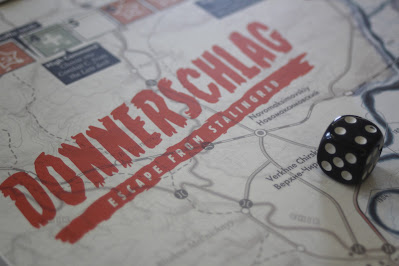
Saturday’s afternoon was filled with Donnerschlag: Escape from Stalingrad. The return to war games had long been promised to Augusto Cruz, and finally we made it! It is a return, as war games were, no doubt, the first complex games I played, back in the late 1970's, early 1980's, in this unique combination of strategy, tactics, and historical context, most often choosing World War II for the setting. I am certain there will be more sessions to come in the near future, because there is plenty of material to explore in both our collections. 

Donnerschlag recreates an operation planned by the German forces to liberate their 6th Army, besieged at Stalingrad. Hexagons and counters. Asymmetrical forces and positioning. The use of terrain features, in particular rivers and bridges. Advances and delays. Increased mobility against reinforcements. Initiative and the time that is running out. Activation and combat cards. Combat resolution tables and dice. A hidden objective: the meeting point with the 6th Army.

The session lasted for the whole afternoon, not because the game play itself was slow, but because there were lots of ongoing conversations. Between the two of us, with those who stopped by out of curiosity for an unfamiliar game genre, with those more used to the cardboard battlefields, and with so many now familiar faces, present convention after convention. All these moments of sharing are one of the best features of such events! As for the game, the suspense on the outcome persisted until the final moment of the last turn: the German forces arrived at the planned meeting location but did not resist the Soviet's last breath.

Donnerschlag, a war game by Patrick Gebhardt and Pepito Shazzeguti, published by VUCA Simulations. As a side note, I made some comments to an earlier version of the rules, and so my name is featured in the acknowledgement's section!


The ambiance was excellent, as always! Lots of people, plenty of games to choose from, a nice set of prizes to raffle, thanks to the sponsors who supported the convention, a room full of light, and an exemplary and welcoming organization 😊


there was nothing planned in advanced for Sunday’s afternoon. But then came the opportunity to playtest a prototype from the game desingers João Quintela Martins and Vital Lacerda: the Santa Justa Elevator. It was a three-way session, together with João Quintela, the author, and João Pimentel, in goos spirits and with a good discussion about the current stage of the game, design questions, suggestions, and potential for future developments. How I enjoy seeing, and being able to participate, in such projects under construction!

Cool things about these interconnected communities: a video shared by João Quintela Martins, a reaction from Julián Pombo, the Uruguayan game designer of Pampero (among others), who I met at this year's LeiriaCon while testing one of his latest prototypes, and an unexpected intercontinental exchange of greetings!


The sun is setting, and RiaCon will return next year, for sure. Until then, the Portuguese convention route continues. The next participation will most likely be at VianaCon. In the meantime, in these pages, there will also be flashbacks from the Cannes International Gaming Festival and LeiriaCon. I need only to find time enough to write them down.

3 February 2023

Working in the land of games

Design by Leonor Conceição

 
Life in the land of games has been intense and diversified! Not exactly playing games, but rather making a contribution towards games that already are, and games yet to be. Increasing their accessibility through clear rules, precise wording, and, whenever possible, making them available in Portuguese.

If you want to know some more on what I've been doing, with whom I have been collaborating, on which games, across which geographies even if without leaving this place, as well as some opinions on my work, check my portfolio, here

   Development, editing, and proofreading rule books. 

   Translation                                                               Narrative writing

   Playtests                                                                   Juri and coach in game design contests

   Exhibitions                                                               Presentations
   Interviews and conversations


30 December 2022

Of Kings & Queens, trolls, goblins, and more


The final session had come to an end, and the workday was done. The lift brings me back to the ground floor. The doorway leads me into the city rush. The night has already settled in. No rain, cold air, but not too much, good enough for a walk. Much better than to dive into the underground tunnels, to reappear in another place, as if jumping between two unconnected points. It is late November, 6 pm.

From Rondpoint Robert Schuman and heading towards the city centre. A stroll all the way down Rue de La Loi. The streets are flooded with light, from the sidewalk lamps above, from slowly moving cars, drawing lines of white and trails of red, from electric scooters and bicycles, moving fast. 

I am now crossing Rue Royale to enter the pentagon-shaped inner city. Further ahead, on the right, the Saint Michel and Saint Gudule Cathedral. A couple of streets more, la Place du Marché aux Herbes. Familiar names and familiar sights, maybe because I have been here in three or four occasions before, always work-related. The first probably dating to the 1990’s, and the last to early 2018, for a job interview at the European Parliament. Yes, this is Brussels.

Then, La Grande Place, with its adorned Christmas tree, chimes resounding in the background. Shopping malls, street shops, cafes and restaurants. Lights and sounds. People moving hastily, bags in hand. Others in loud conversations. Still others just contemplating and taking pictures, freezing time, for the now or for the later. Shoppers, tourists, and residents. Locals, nationals, and foreigners like myself. 


It is now 7 pm. Just about time to head to the next destination, following one of the game-related locations Orlando Sá suggested. One which is still open and where I may have something to eat. 

A short five-minute walk to a street bearing an appropriate name for this quest, la Rue du Fossé aux Loups, Wolvengracht. Well, it seems that the street name may be linked to a man named Wolf, and not to the creatures themselves, but anyhow. Pretty easy to identify, with the large sign above the door: Kings & Queens. Yes, that’s the place. A Board Game Café. That reminds me that I still have an overdue visit to pay to A Jogar é que a Gente se Entende, back in Portugal. A promise for 2023!

The place is almost deserted, if not by two pairs engaged in some sort of game with miniatures, close to the door, and a couple by the counter, sipping their cocktails and engaged in a conversation with the barman. I chose one of the many empty tables, well sized for gaming, drop the coat on the back of one of the chairs and the notebook on the table. Linkin Park is playing low in the background, followed by The Queen. It feels cozy in there.

The concept of the Game Bar is simple. For five euros per person, you can play all the games you want from the on-site game library. You may even get some assistance regarding game rules. Playing games will not be on my menu for today, but a tasty pizza and a Cuvée des Trolls, a Belgian beer with history - what else? -, will do the job. 

First, the mandatory glance at the game library. More than 300 games on the shelves, from party games to medium euros, to some of the classic heavy weights. Familiar covers on display: Takenoko, Wingspan, Anachrony, and many, many more.

Back to the table. There still is not a great deal of movement. A group of three in search of some game, sitting down and getting ready to play. A couple more entering and leaving. Is it because of the nearby holiday season, for being a late afternoon in the middle of the week, or a side effect of yet another rail-strike? 


I decided to join Thomas, the barman, at the counter, and learn more about the place. As the conversation started to flow, my French surfaced, even if somewhat rusty. 

The café-bar is in operation for just over four years, meaning that the pandemic restrictions were in place during a substantial part of its existence. It survived the hardships, and a rent to pay in the city center, without much of a support. Converted into a temporary take-away, as many other similar businesses, losses were somewhat attenuated. It survived, but not unscathed, with projects put on hold, and only gradually getting back to full action.

The business seems now well on the rise. From regular clients to occasional visitors, from a corporate day-out to team building exercises. Apparently I have chosen what is proving to be the quietest day of the last three to four weeks. 

As for Thomas, he has been there for about a year. A passionate by the art of cocktail-making, and serving, something that always fascinated me, he learned the tricks of the trade as hotel barman. The knowledge, the experimentation, the creativity, connecting people, providing new experiences, suggesting, guiding. 

From drinks to games, with so many points in common. The importance of knowing the trade and understanding the people sitting on the stool or around the tables. Presenting them with new flavours, new games, new experiences. Creating a welcoming space, for them to return. Overall, contributing for people to spend good moments together, over a drink or two, over a boardgame table, over both. The barman and the boardgame expert alike. The game connoisseur here is the founder and owner, Athanasios, but he is not there today.

The conversation drifts. The meaning of being a Belgian. Traveling the world and choosing to work in Brussels. People’s roots, spread all over the continent, Belgium, Greece, Luxembourg, Portugal. And all over the world. Nationalism and internationalism. Openness and segregation. Togetherness and divisions. Harmony, struggles, and dangers.

Well, time flies, and I say goodbye to Kings & Queens. Thank you, Thomas! A walk back to the hotel, a night of sleep, and an early morning trip to the airport. Hope to be back and, next time, I will be playing some games!


https://www.facebook.com/KingsQueensCafe/

5 November 2022

Far beyond the horizon


Setting sail. Like this ship, in early September 2016. That was The Year of the Monkey. A year full of departures into the unknown, breaking with well-established routines.  Changing course, in the book holding the same name, authored by Patti Smith, as in real life.

Setting sail. October 2018. The start of a countdown, which may not have existed without the preceding events. All dots connected. Heading (back) to the land of games. It all started by bringing together words, photos, games, and languages. Things I enjoy. Shaping a blog.  With a vague notion of wanting to be more involved in the world of board games. Without much of a plan. Just wandering around. Craving for the journey. Even with no safe shores in the horizon.

Fast forward to four years later. Things went ways I wouldn’t have dreamed off, when leaving harbour. Looking back at a list of 10, made within this period, in no particular order and selected among many others:


Over 50 rule book translations, increasing accessibility, with a fair number for MasQueOca and for TheGeekyPen, including games such as Concordia and Pavlov’s House. Thank you, José Antonio and Jo Lefebure, for the initial opportunity and the continuous trust!

Interviews with Dávid Turczi, Sabrina Miramon, Sarah Shah, and Don Woods, who so kindly accepted to give some of their time and to share insights on board games with a small audience blog.

Short stories for presenting The Isle of Cats, courtesy of Frank West when kindly reaching out for small content producers, and Welcome to Sysifus Corp., thanks to Wonmin Lee.

The lore for Ynaros Fallin’ main story and scenarios, thanks to the trust and creative freedom provided by Ugo Tomasello, and the very professional way of running his very first game design and production. A game soon hitting Kickstarter.

Judge and coach in The Board Game Workshop Design Contest, aimed at games under development, thanks to all the work of Chris Anderson, and the welcoming environment created.

Learning from Paul Grogan, always welcoming and willing to share his knowledge and approaches, and being able to make some minor contributions in the backstage of Gaming Rules! An invaluable opportunity for someone who loves rulebooks and rulebook-related work in its different forms.

Collaborating with Orlando Sá in the final development stages of Rossio and Pessoa, always open to opinions and to share his vision and expertise, which also lead to other conversations, far beyond games. Thank you for your friendship!

Playtesting games such as The Smoky Valley (Claude Sirois, Spielworxx), Lanzerath Ridge (David Thomson, Dan Verssen Games), and That Others May Live (Brad Smith, Hollandspiele – upcoming), amongst others.

A talk at LeiriaCon, the most international Portuguese boardgame convention, courtesy of Micael Sousa, where I covered over 50 years of (my) games in not much more than 10 minutes!

A board game exhibition, at the University of Aveiro, Portugal, thanks to Margarida Almeida, who made me think about games as a collection and how to display it for benefit of larger audiences. An unexpected and rewarding challenge!


The voyage continues!

29 October 2022

Weekend in Viana do Castelo, Portugal


Friday afternoon, October 21. Time to head north towards Viana do Castelo, for the third convention of the year, after LeiriaCon and RiaCon. This time, finally, for a full stay, to make the most of this opportunity for encounters, re-encounters, and discoveries at the table. 

A road trip in tones of gray, anticipating the contrast with the colours awaiting for us. Arriving just in time for the check-in, a glance at Santa Luzia’s hill, already in the darkness, and a quick dinner in an almost deserted place, where a football match was more discussed than watched.


VianaCon had indeed already begun in the afternoon, with a session addressed to schools. For me, it began in the evening, at the Café Concerto of the Theater Sá de Miranda, a different setting for welcoming participants and occasional visitors. 

Time for the first meetings, a table to avoid the more traditional seats, a quiz about games, what else, and a first prototype to try out. In the company of Pedro Santos and Maria Mota, both very strong in the questions and answers, and André Santos, the author of the game, which follows a Roll'n Write developed in pandemic times, and Neotopia, soon to be published. Serious prototype riding, stretching strategies to the limit, discussing processes, debating fine-tuning.


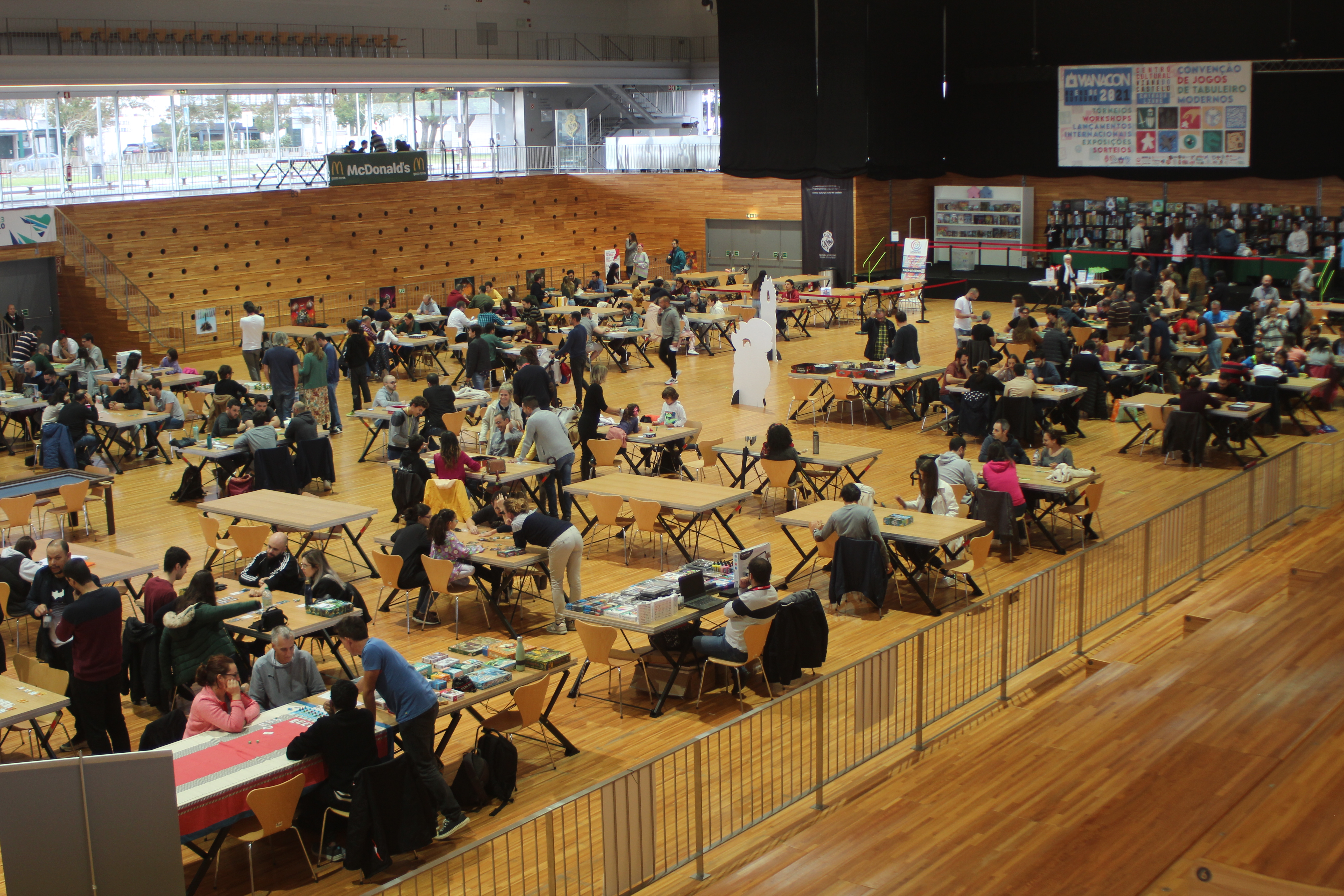
Saturday, the first day at the Cultural and Congress Center, with a cozy interior made of wooden tones, and the Lima River just outside the windows. An excellent venue for this kind of events, with tables of generous dimensions. Maybe a coffee zone was the single item missing, to reset the levels throughout the day!

Meeting people. Marlene and Luís, from Salta da Caixa, and their new projects that will bring more games in Portuguese. Manuel, from the boardgame café A Jogar é que a gente se entende, even when having the youngest family member sleeping in his lap (not yet the opportunity to pay visit to the café…). Luís Baixinho, one of the organizers, with whom we talked about science fiction and teaching (both fans of the brilliant short story Profession, by Isaac Asimov), and from Lego to board games of the 80s. Pedro Kerouac, a familiar partner at these conventions. Hugo, with some games in development, and a play test scheduled for InvictaCon. Nuno Rebelo and the future of the Boardgamers of Aveiro. Among others.

Also a first meeting with João Cotrim, partner in recent translations and proofreading of rule books, for the Belgian company The Geeky Pen.


Then, finally (!), it was time to meet Orlando Sá in person. Our first contacts began, like so many others, in Facebook gaming groups. Later, came an unexpected invitation to try out Rossio, one of his boardgames, then in the near-final development stage, and the fine-tuning of the solo mode. The collaborations went on to the most recent published game of his, Pessoa, and extended to various conversations and ideas, cycling included. It is so great that, in this gaming world, we may use virtual and physical spaces, taking advantage of both!

This time around, even with an added bonus: a very interesting workshop on the creation and development of games, from idea to prototypes, from play tests to rule books, from the home table to pitching to publishers.


Afterwards, it was time to play and to discover new games. If, in Leiria, I almost exclusively played prototypes, in different stages of development, this time around I opted to play games already published, recent ones or not that much. Sharing with Tiago, Sérgio, Eduardo, Filipa, Nuno, Pedro Kerouac and Luís Júnior.


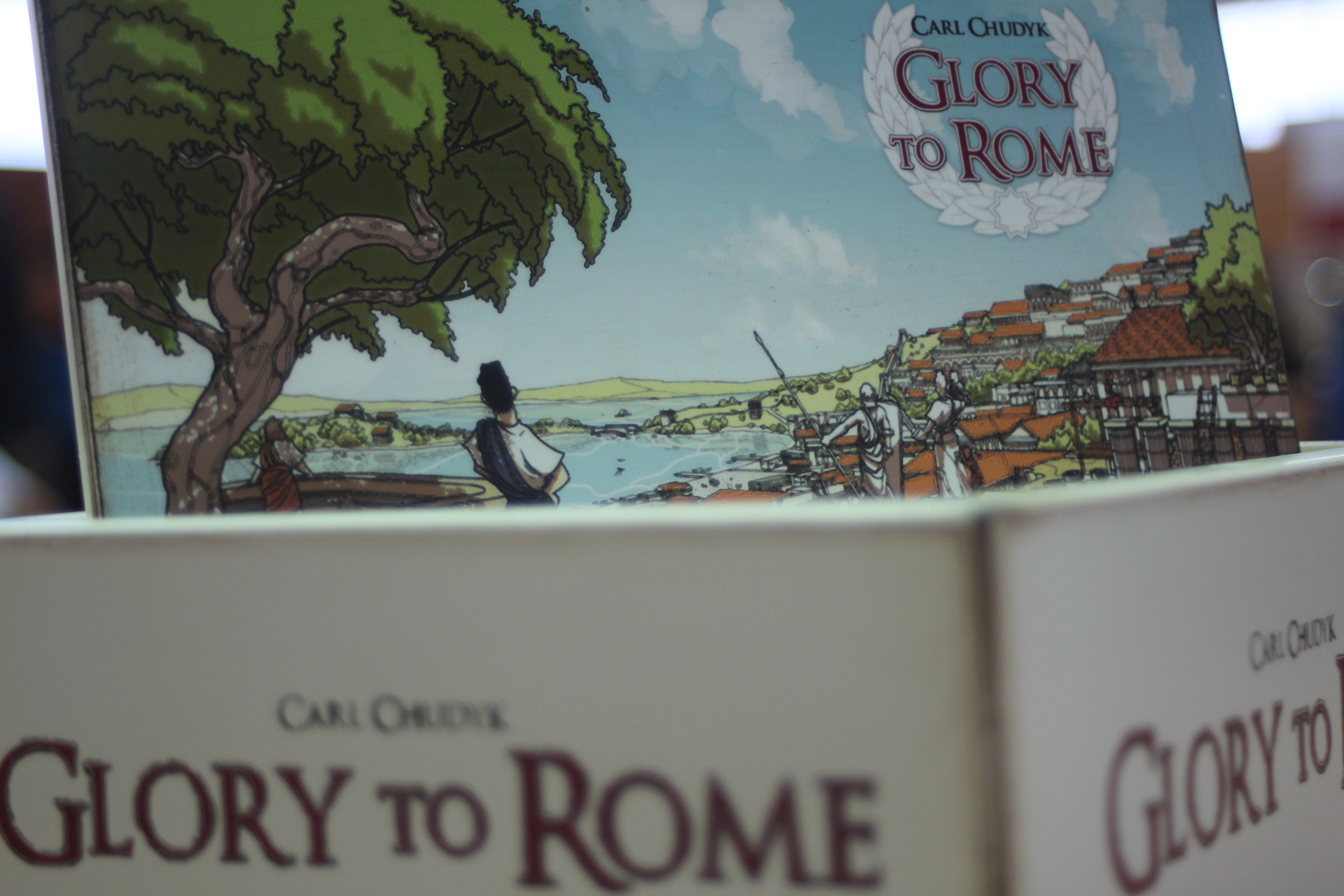
Glory to Rome - Managing characters to rebuild the city 


Parks - Hiking across US National Parks

Sobek - Gathering resources in Ancient Egypt


Abomination - In the footsteps of Frankenstein


Viticulture - Wine making in Tuscany